


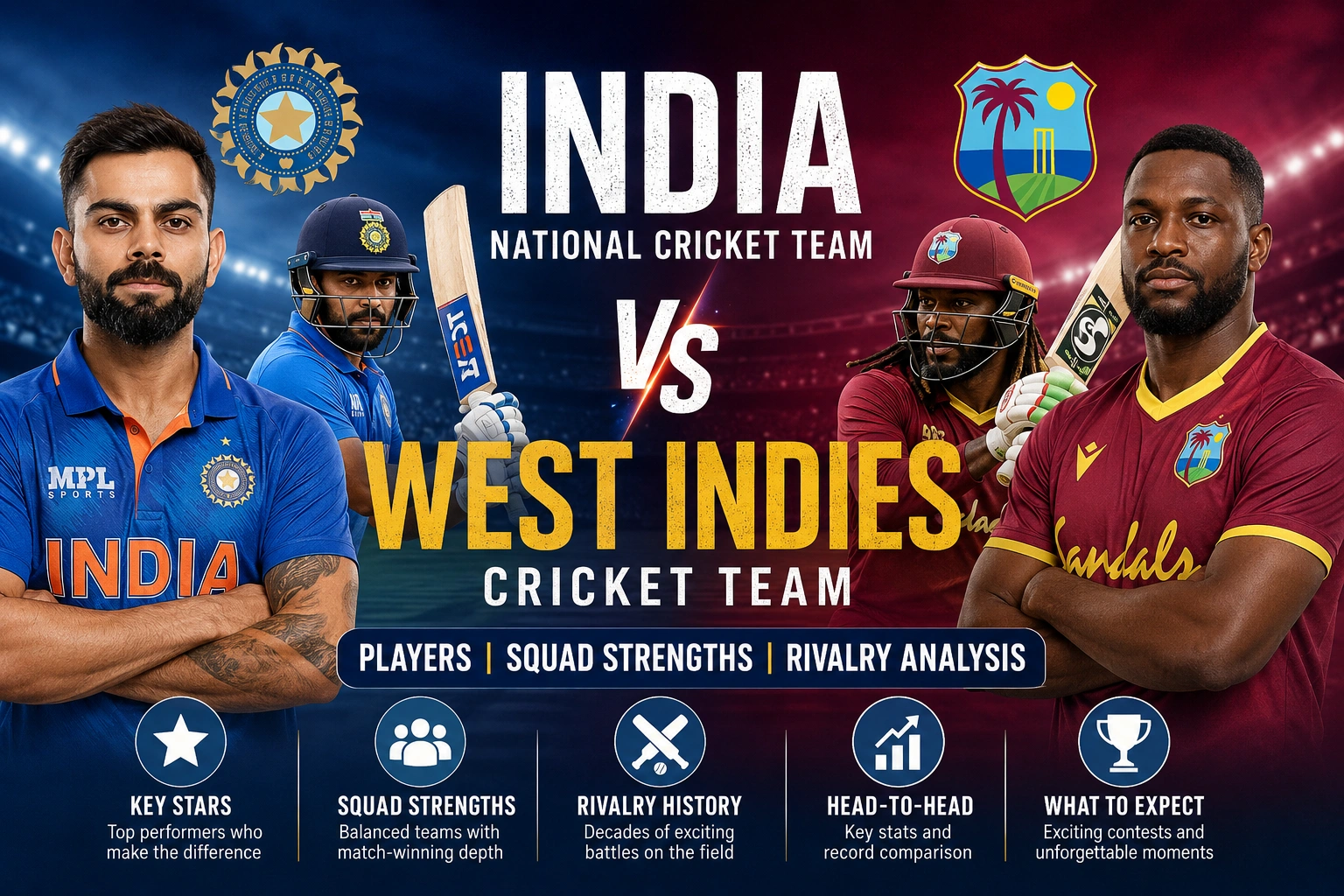
The India national cricket team vs West Indies cricket team players matchup brings together two sides with very different cricketing identities but plenty of proven talent. India generally offer deep batting and bowling resources, while West Indies remain dangerous through power-hitting, athletic fielding and versatile all-rounders.
Read Also: Ireland Cricket Team vs India National Cricket Team Players: Full Squad Guide
For a current player comparison, the exact squad depends on the format and series. West Indies’ 2026 T20 World Cup group included Jason Holder, Roston Chase, Shai Hope, Brandon King, Shimron Hetmyer, Romario Shepherd, Sherfane Rutherford, Akeal Hosein and Gudakesh Motie, among others.
Quick Answer: India vs West Indies player lists vary by format and selection. India’s recent white-ball groups have featured names such as Shubman Gill, Shreyas Iyer, Abhishek Sharma, Tilak Varma, Ishan Kishan, Axar Patel and Arshdeep Singh, while West Indies’ leading players include Shai Hope, Jason Holder, Roston Chase, Brandon King, Shimron Hetmyer and Sherfane Rutherford.
India vs West Indies Players: Why the Matchup Matters
India and West Indies have produced some memorable international cricket encounters across Tests, ODIs and T20Is. The contrast in playing styles is one reason the fixture remains compelling.
India’s modern white-ball setup is built around batting depth, flexible all-rounders and multiple bowling options. West Indies can counter that with explosive top-order hitters, tall seamers, wrist-spin and powerful lower-order batting.
The important detail for readers checking an India vs West Indies squad is the format. A Test squad can look completely different from a T20I group, and even two T20I series can involve different selections because of workload, injuries and player availability.
Who Are the Key India Cricket Team Players?
India’s player pool in 2026 includes a blend of established internationals and younger T20 specialists. Recent BCCI selections show how quickly the group can change between assignments.
Shubman Gill
Shubman Gill remains one of India’s leading top-order batters and was named captain for the 2026 ODI series against England. His role is particularly important in longer white-ball formats, where controlling the opening phase can shape an entire innings.
Gill’s batting is based on timing and control rather than relying solely on power. That makes him a useful counterpoint to more aggressive players in India’s T20 setup.
Shreyas Iyer
Shreyas Iyer became India’s T20I captain for the team’s 2026 assignments against Ireland and England. His appointment marked a significant leadership transition following India’s T20 World Cup campaign.
Iyer also offers experience in the middle order. His ability to rotate strike while accelerating against spin makes him an important tactical player.
Abhishek Sharma
Abhishek Sharma is one of India’s most aggressive T20 opening options. His value comes from his ability to attack during the powerplay and put pressure on bowlers before fielding restrictions disappear.
That approach makes him particularly interesting against West Indies, whose attack often contains pace and spin options capable of changing their lengths quickly.
Tilak Varma
Tilak Varma has developed into an important left-handed batting option for India. He was named vice-captain for India’s 2026 T20I assignments against Ireland and England.
His left-handed presence can also help India create more favourable matchups against right-arm bowlers and off-spin.
Ishan Kishan
Ishan Kishan provides India with another aggressive wicketkeeper-batter option. His ability to attack pace in the powerplay gives selectors flexibility when building the top order.
India have also used Sanju Samson in the wicketkeeper role, meaning the team can choose between different batting profiles depending on the conditions and tactical requirements.
Axar Patel
Axar Patel gives India balance because he contributes in multiple departments. He can bowl economical left-arm spin, bat in the middle or lower order and add value in the field.
That all-round ability is especially useful in T20 cricket, where one extra bowling option can change how a captain manages the innings.
Arshdeep Singh
Arshdeep Singh is a key left-arm pace option for India. His ability to operate with the new ball and return at the death gives the team a different angle from its right-arm fast bowlers.
For a West Indies matchup, his variations and left-arm angle can be particularly useful against aggressive right-handed batters.
Who Are the Key West Indies Cricket Team Players?
West Indies have a deep pool of players with contrasting skills. Their 2026 T20 World Cup squad illustrates that range, featuring established batters, experienced all-rounders and specialist spin and pace options.
Shai Hope
Shai Hope was listed as West Indies captain in the team’s 2026 T20 World Cup squad. He combines wicketkeeping with top-order batting and has developed into an important leader for the side.
His role is slightly different from a pure power hitter. Hope can build an innings while still accelerating when the situation demands it.
Jason Holder
Jason Holder remains one of West Indies’ most versatile cricketers. He contributes with the ball, provides lower-order hitting and offers leadership experience.
His height also gives him the ability to generate bounce that can trouble batters on suitable surfaces. At the 2026 T20 World Cup, he was selected in the ICC Team of the Tournament after taking 10 wickets and scoring 141 runs.
Roston Chase
Roston Chase is another important all-rounder for West Indies. His value comes from being able to influence the match with both batting and bowling.
In a T20 side, that flexibility allows the captain to build a more balanced XI without sacrificing batting depth.
Brandon King
Brandon King provides West Indies with a powerful top-order option. He is capable of attacking the new ball and changing the tempo quickly.
Against India, that aggression can be especially valuable because getting through the Indian powerplay attack without losing wickets can create a platform for a big total.
Shimron Hetmyer
Shimron Hetmyer is one of West Indies’ most experienced middle-order batters. His left-handed power makes him a natural option when the team needs acceleration during the middle and final overs.
He can also create difficult bowling matchups when India use conventional right-arm pace or off-spin.
Sherfane Rutherford
Sherfane Rutherford is another left-handed power hitter who can change a T20 innings quickly. He is particularly valuable when West Indies need runs during the final five or six overs.
His presence alongside players such as Hetmyer, Holder and Romario Shepherd gives West Indies significant late-innings hitting potential.
Akeal Hosein and Gudakesh Motie
West Indies’ spin department includes Akeal Hosein and Gudakesh Motie. Both provide left-arm spin, but they can be used in different phases depending on the match situation.
Spin can be particularly important against India because middle overs often determine whether a T20 chase remains under control or becomes difficult.
India vs West Indies Players Comparison
| Area | India | West Indies |
|---|---|---|
| Leadership options | Shubman Gill, Shreyas Iyer | Shai Hope, Jason Holder |
| Top-order batting | Shubman Gill, Abhishek Sharma | Brandon King, Shai Hope |
| Middle-order power | Tilak Varma, Ishan Kishan | Hetmyer, Rutherford |
| All-round options | Axar Patel, Washington Sundar, Shivam Dube | Jason Holder, Roston Chase, Romario Shepherd |
| Spin options | Axar Patel, Ravi Bishnoi, Washington Sundar | Akeal Hosein, Gudakesh Motie |
| Pace options | Arshdeep Singh, Jasprit Bumrah, Prasidh Krishna | Jayden Seales, Shamar Joseph, Matthew Forde |
The difference between the two teams is not simply about individual ability. India generally offer greater selection depth, while West Indies can create a particularly dangerous combination of power-hitting and all-round skills.
How Do India’s Players Match Up Against West Indies?
The key battle usually starts during the powerplay.
India can use aggressive openers to attack West Indies’ fast bowlers, while West Indies will want early wickets before India’s middle order gets settled.
The middle overs create another tactical contest. India’s spin and all-round options can restrict scoring, but West Indies have several batters capable of clearing the boundary even when the field spreads.
At the death, the contest becomes even more direct. India’s pace attack has specialists for the final overs, while West Indies can rely on powerful hitters such as Rutherford, Hetmyer, Holder and Shepherd.
Which Players Could Decide an India vs West Indies Match?
Several matchups deserve attention whenever the sides meet.
1. India’s top order vs West Indies’ new-ball attack
India’s opening batters need to score quickly without exposing the middle order too early. West Indies’ seamers will look for movement and early wickets.
2. West Indies’ power hitters vs India’s death bowling
This is one of the most entertaining battles. West Indies have players who can score 15 to 20 runs from an over when they get their range.
India’s death bowlers therefore need variations, yorkers and smart changes of pace rather than simply bowling for speed.
3. Spin in the middle overs
The middle overs can decide the direction of a T20 match. India’s spinners may try to force West Indies into riskier shots, while West Indies’ left-arm spinners can challenge India’s right-handed batters.
4. All-rounders and squad balance
All-rounders often determine which side can afford to select an extra specialist bowler or batter. Players such as Axar Patel, Holder and Roston Chase give their captains more tactical options.
How Do India and West Indies Build Their Playing XI?
A squad is not the same thing as a playing XI. This distinction matters when researching “India national cricket team vs West Indies cricket team players.”
Only 11 players can take the field in an international match, while the wider squad may contain considerably more options.
Before comparing the actual teams, check:
- Format: Test, ODI or T20I.
- Final squad: Look for late replacements.
- Playing XI: Confirm who was selected for the match.
- Toss: Batting and bowling decisions can affect the lineup.
- Pitch: Conditions can influence the number of spinners or seamers.
- Player availability: Injuries and workload management frequently change squads.
This approach prevents a common mistake: treating every player named in a squad announcement as someone who necessarily played the match.
Why India vs West Indies Remains a Fascinating Player Battle
India bring a highly structured approach to international cricket, with strong depth across batting, spin and pace. West Indies bring a different kind of threat, particularly when their power hitters and all-rounders are firing.
The teams also represent different cricketing traditions. India’s enormous domestic talent pool provides constant competition for places, while West Indies’ best players often develop through a combination of regional cricket, international cricket and global T20 leagues.
That contrast can produce unusual matchups. A technically strong Indian batter may be challenged by a tall West Indian seamer, while a West Indian power hitter may have to negotiate India’s variations in spin.
What Should You Check Before a Future India vs West Indies Match?
For the most accurate player information, don’t rely on an old squad article alone. Selection can change quickly.
A useful pre-match checklist is:
- Check the latest official squad announcement.
- Confirm injury and replacement news.
- Review the final playing XI after the toss.
- Compare recent batting and bowling form.
- Look at the venue and pitch characteristics.
- Check whether the match is a Test, ODI or T20I.
This is especially important in 2026 because both teams have continued to rotate players across formats and assignments.
Key Takeaways
- India and West Indies have deep pools of international cricket talent across all three formats.
- India’s recent white-ball selections have included Shubman Gill, Shreyas Iyer, Abhishek Sharma, Tilak Varma, Ishan Kishan, Axar Patel and Arshdeep Singh.
- West Indies’ 2026 T20 World Cup squad included Shai Hope, Jason Holder, Roston Chase, Brandon King, Shimron Hetmyer and Sherfane Rutherford.
- Jason Holder was selected in the ICC Team of the Tournament for the 2026 T20 World Cup after producing 141 runs and 10 wickets.
- The most important player comparison depends on the format, venue and final playing XI.
- Squad announcements should always be distinguished from the XI that actually takes the field.
Frequently Asked Questions
Who are the key players in India vs West Indies cricket?
India’s key names include Shubman Gill, Shreyas Iyer, Abhishek Sharma, Tilak Varma, Axar Patel and Arshdeep Singh, depending on the format. West Indies have players such as Shai Hope, Jason Holder, Roston Chase, Brandon King and Sherfane Rutherford.
Who is the captain of India?
India’s captain depends on the format and series. Shubman Gill was named ODI captain for the 2026 England series, while Shreyas Iyer was appointed T20I captain for the Ireland and England assignments.
Who is the captain of West Indies?
Shai Hope was listed as captain of West Indies’ 2026 T20 World Cup squad. Captaincy can change between formats or series, so the latest official squad should be checked for a specific fixture.
Who is the best all-rounder in India vs West Indies?
There isn’t one objective answer because the roles differ. India’s Axar Patel and West Indies’ Jason Holder and Roston Chase are strong examples of players who can influence matches in more than one discipline.
Which West Indies players are dangerous in T20 cricket?
West Indies have several T20 match-winners, including Brandon King, Shimron Hetmyer, Sherfane Rutherford, Jason Holder and Romario Shepherd. Their combination of power hitting and all-round ability can change a match quickly.
Is the India vs West Indies squad the same for every match?
No. Squads and playing XIs can change because of format, injuries, workload management, conditions and selection strategy. The final XI should always be checked against the specific match being discussed.
Conclusion
The India national cricket team vs West Indies cricket team players matchup is less about a simple list of names and more about how contrasting skill sets fit together. India have substantial depth across batting, bowling and all-round options, while West Indies possess the power and versatility to make any white-ball contest competitive.
Players such as Shubman Gill, Shreyas Iyer, Abhishek Sharma and Axar Patel represent different parts of India’s modern setup. West Indies can counter with Shai Hope, Jason Holder, Roston Chase, Brandon King, Hetmyer and Rutherford.
For anyone following a future India vs West Indies fixture, the smartest approach is to check the latest squad first and the confirmed playing XI second. That small distinction gives a much more accurate picture of who is actually expected to shape the match.
