


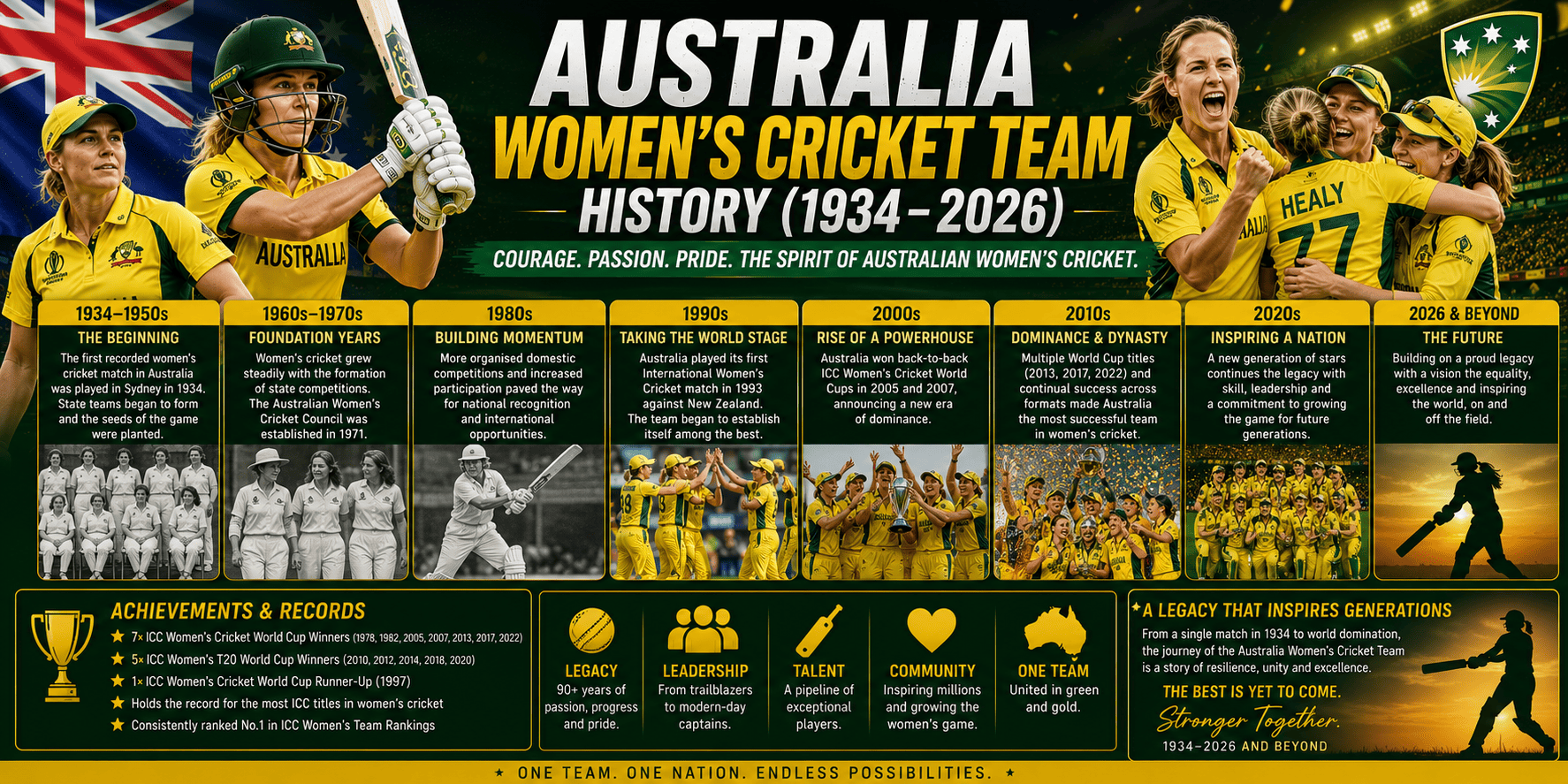
Few national teams have dominated an international sport as completely as the Australia Women’s Cricket Team.
Australia Women’s Cricket Team History
From their first Test match in 1934 to becoming the most successful side in the history of women’s cricket, Australia have built a legacy founded on excellence, innovation, and remarkable consistency. Across generations, the team has produced legendary captains, world-class batters, elite fast bowlers, and all-rounders who have redefined the women’s game.
Australia’s achievements extend beyond trophies. Their commitment to professional contracts, player development, domestic competitions, and high-performance coaching has helped transform women’s cricket from a largely amateur pursuit into one of the world’s fastest-growing sports.
Today, the Australian women’s team is regarded as the benchmark of international cricket, having won more ICC titles than any other nation and inspired countless young cricketers across the globe.
Quick Facts
| Category | Details |
| Country | Australia |
| Governing Body | Cricket Australia |
| Nickname | Southern Stars (formerly), Australia Women |
| First Test Match | December 1934 vs England |
| Test Cap Number 1 | Margaret Peden |
| First ODI | 1973 vs International XI |
| First T20I | 2005 vs New Zealand |
| ICC Women’s ODI World Cup Titles | 8 |
| ICC Women’s T20 World Cup Titles | 7 |
| Commonwealth Games Gold | 2022 |
Australia Women’s Cricket Timeline (1934–2026)
| Year | Milestone |
| 1934 | Played first-ever Women’s Test against England in Brisbane. |
| 1935 | Drew the inaugural Women’s Ashes series. |
| 1973 | Competed in the first Women’s Cricket World Cup. |
| 1978 | Won first Women’s Cricket World Cup. |
| 1982 | Successfully defended the World Cup. |
| 1988 | Won a third consecutive ODI World Cup. |
| 1997 | Belinda Clark captained Australia to another World Cup title. |
| 2005 | Karen Rolton starred in Australia’s fifth ODI World Cup triumph. |
| 2009 | Women’s cricket became fully integrated into Cricket Australia’s high-performance pathway. |
| 2010 | Won the ICC Women’s T20 World Cup. |
| 2012 | Won a second Women’s T20 World Cup. |
| 2013 | Won the ICC Women’s ODI World Cup in India. |
| 2014 | Won a third ICC Women’s T20 World Cup. |
| 2018 | Won the ICC Women’s T20 World Cup in the West Indies. |
| 2020 | Won the ICC Women’s T20 World Cup before a record crowd at the MCG. |
| 2022 | Won the ICC Women’s Cricket World Cup and Commonwealth Games gold. |
| 2023 | Won the ICC Women’s T20 World Cup in South Africa. |
| 2024–2026 | Continued among the world’s leading women’s cricket teams across all formats. |
The Early Years (1934–1972)
Women’s international cricket began long before the ICC formally organized the modern game.
Australia played their inaugural Women’s Test against England at the Brisbane Exhibition Ground in December 1934 under captain Margaret Peden. The match ended in a draw, but it marked the beginning of one of cricket’s greatest rivalries—the Women’s Ashes.
During the following decades, international fixtures remained limited. Tours were infrequent, financial support was minimal, and players often balanced cricket with full-time employment.
Despite these challenges, Australia consistently remained among the strongest women’s teams in the world.
The Birth of World Cup Success
The first Women’s Cricket World Cup took place in 1973, remarkably two years before the inaugural men’s tournament.
Australia narrowly missed the title in England but quickly established themselves as the dominant force in subsequent editions.
Women’s ODI World Cup Titles
| Year | Final Opponent | Result |
| 1978 | England | Won by 8 wickets |
| 1982 | England | Won by 3 wickets |
| 1988 | England | Won by 8 wickets |
| 1997 | New Zealand | Won by 5 wickets |
| 2005 | India | Won by 98 runs |
| 2013 | West Indies | Won by 114 runs |
| 2022 | England | Won by 71 runs |
Winning three consecutive World Cups between 1978 and 1988 established Australia as the first great dynasty in women’s cricket.
The Belinda Clark Revolution
Few individuals have shaped women’s cricket more profoundly than Belinda Clark.
Taking over as captain during the 1990s, Clark transformed Australia’s culture through professionalism, tactical preparation, and exceptional standards.
Under her leadership:
- Australia won the 1997 World Cup.
- Australia defended the title in 2005.
- Fitness standards improved dramatically.
- Women’s cricket received increased investment.
Clark also became the first cricketer, male or female, to score a double century in a One-Day International, making 229* against Denmark in 1997.
Professional Era and Global Dominance
The late 2000s marked a turning point.
Cricket Australia increased investment in women’s cricket through central contracts, sports science, and professional coaching.
The results were extraordinary.
Australia not only remained the world’s best ODI side but also became the dominant force in T20 cricket.
ICC Women’s T20 World Cup Titles
| Year | Final Opponent |
| 2010 | New Zealand |
| 2012 | England |
| 2014 | England |
| 2018 | England |
| 2020 | India |
| 2023 | South Africa |
| 2026 | England |
The team’s ability to adapt to cricket’s shortest format demonstrated the depth of Australia’s talent pool.
The MCG Moment That Changed Women’s Cricket
On 8 March 2020, Australia defeated India in front of 86,174 spectators at the Melbourne Cricket Ground.
It remains one of the most important matches in women’s sporting history.
Beth Mooney’s unbeaten 78 and Australia’s dominant bowling attack secured another T20 World Cup title, but the lasting legacy was the record attendance.
The match demonstrated the commercial and cultural growth of women’s cricket worldwide.
Australia’s Greatest Players
Legendary Batters
- Belinda Clark
- Karen Rolton
- Meg Lanning
- Alyssa Healy
- Beth Mooney
- Lisa Keightley
- Rachael Haynes
Great All-rounders
- Ellyse Perry
- Lisa Sthalekar
- Shelley Nitschke
- Ashleigh Gardner
Also Read: Top 10 Greatest Women’s Cricket All-Rounders Ever
Outstanding Bowlers
- Cathryn Fitzpatrick
- Megan Schutt
- Jess Jonassen
- Rene Farrell
Each generation has successfully replaced retiring legends with new stars—a defining characteristic of Australian cricket.
Greatest Captains
| Captain | Era | Major Achievements |
| Margaret Peden | 1934–1937 | First Australian Women’s Test captain |
| Lyn Larsen | 1980s | World Cup-winning captain |
| Belinda Clark | 1990s–2005 | Two World Cup titles; transformed professionalism |
| Jodie Fields | 2010–2014 | 2013 ODI World Cup winner |
| Meg Lanning | 2014–2023 | Multiple ICC titles across ODI and T20 formats |
| Alyssa Healy | 2024–Present | Leading Australia’s Captain |
Australia’s ICC Trophy Cabinet
| Tournament | Titles |
| Women’s ODI World Cup | 8 |
| Women’s T20 World Cup | 7 |
| Commonwealth Games | 1 |
| Total Major Global Titles | 16 |
No other women’s team has won as many major ICC trophies.
Why Australia Have Dominated
Several factors explain Australia’s sustained success.
Elite Domestic Competitions
The Women’s National Cricket League (WNCL) and Women’s Big Bash League (WBBL) provide one of the strongest development pathways in world cricket.
Professional Investment
Cricket Australia was among the earliest governing bodies to fully professionalize its women’s programme through contracts, sports science, and specialist coaching.
Remarkable Depth
Few nations have consistently replaced world-class players so effectively.
Belinda Clark gave way to Karen Rolton.
Karen Rolton was followed by Meg Lanning.
Meg Lanning’s generation included Alyssa Healy, Ellyse Perry, Beth Mooney, Ashleigh Gardner, Annabel Sutherland, and Phoebe Litchfield.
Winning Culture
Australia’s greatest strength has been maintaining elite standards regardless of changing personnel.
Team Records
| Record | Achievement |
| Most Women’s ODI World Cup Titles | 8 |
| Most Women’s T20 World Cup Titles | 7 |
| Highest Individual Score in a World Cup Final | Alyssa Healy – 170 (2022) |
| Highest Team Total in a World Cup Final | 356/5 vs England (2022) |
| Highest Women’s Cricket Attendance | 86,174 (MCG, 2020 T20 World Cup Final) |
Legacy
Australia’s influence extends well beyond championships.
Their domestic structure has become a model copied by numerous cricket boards. The success of the WBBL has accelerated professional opportunities worldwide, while Australia’s consistently high standards have raised expectations across international women’s cricket.
Equally significant is the team’s role in inspiring participation. Generations of girls have entered the sport after watching Australian players succeed on the biggest stages, helping transform cricket into one of Australia’s leading women’s sports.
Conclusion
From their first Test in 1934 to becoming the most decorated team in women’s cricket history, Australia’s journey has been one of continuous evolution and sustained excellence. Across more than nine decades, the team has combined exceptional talent, visionary leadership, and a commitment to innovation to build a legacy unmatched in the sport.
While rivals continue to improve and global competition grows stronger, Australia’s record of eight Women’s ODI World Cups, seven Women’s T20 World Cups, and numerous iconic players ensures their place as the benchmark of international women’s cricket.
The story of Australia Women is not simply the story of one successful team—it is the story of how a nation helped shape the modern era of women’s cricket.
