


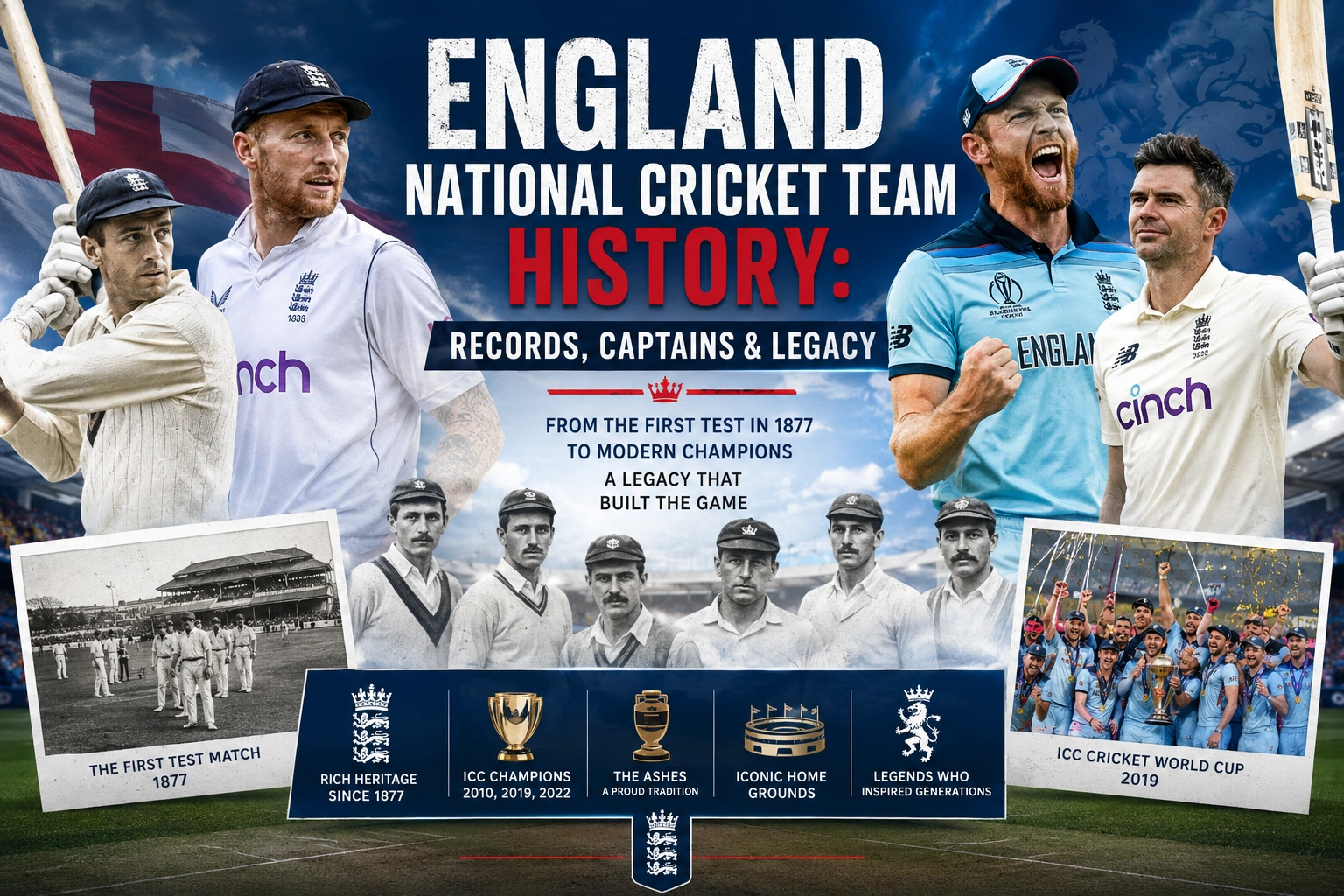
Cricket has evolved dramatically over the past century, but one constant remains—the England national cricket team has been at the heart of the sport’s story. England didn’t just adopt cricket; it shaped it. From hosting the first-ever Test match to lifting modern ICC trophies, the team has experienced unforgettable highs, heartbreaking defeats, and remarkable comebacks. Whether you’re a new fan or a lifelong cricket enthusiast, understanding England’s cricket history offers a fascinating look at how the game itself has evolved.
Quick Summary
- England played the first official Test match in 1877against Australia.
- It is one of the founding members of the ICC.
- England won the 2019 ICC Cricket World Cupand the 2022 ICC Men’s T20 World Cup.
- The team has won 32 Ashes series(as of 2026).
- England has produced legends including Sir Jack Hobbs, Sir Ian Botham, Graham Gooch, James Anderson, Stuart Broad, Joe Root, and Ben Stokes.
- England plays home matches across iconic venues including Lord’s, The Oval, Old Trafford, Headingley, Edgbaston, and Trent Bridge.
The Origins of England National Cricket Team History
The England national cricket team history begins long before international cricket officially existed. Cricket became increasingly popular across England during the 18th century before developing into an organized sport in the 19th century.
Everything changed in March 1877, when England traveled to Melbourne to face Australia in what is now recognized as the first official Test match in cricket history. Australia won that inaugural contest by 45 runs, but a sporting rivalry was born that continues nearly 150 years later.
The England team is administered by the England and Wales Cricket Board (ECB), which oversees professional cricket across England and Wales. Although the team represents two nations administratively, it competes internationally as England.
The Birth of Test Cricket
Test cricket became the ultimate examination of skill, patience, and endurance. England played a central role in developing the format and quickly established itself among the world’s strongest cricketing nations.
During the late 19th and early 20th centuries, England toured Australia, South Africa, India, New Zealand, and the West Indies, helping spread international cricket across the globe.
The Ashes: Cricket’s Greatest Rivalry
No discussion of England cricket history is complete without mentioning The Ashes.
The rivalry originated in 1882, when Australia defeated England at The Oval. A satirical newspaper obituary claimed that English cricket had “died” and that “the body will be cremated and the ashes taken to Australia.”
That playful headline created one of sport’s greatest traditions.
Today, every Ashes series carries enormous significance regardless of rankings or recent form. Historic battles between legends such as Ian Botham and Dennis Lillee, Shane Warne and Andrew Strauss, or Ben Stokes and Pat Cummins have kept the rivalry fresh for generations.
England has produced several unforgettable Ashes victories, including:
- 1981 “Botham’s Ashes”
- 2005 Ashes victory under Michael Vaughan
- 2013 home Ashes triumph
- Multiple dramatic Headingley Test wins
The Ashes remains the benchmark by which many England teams are judged.
England Cricket Records and Major Achievements
England has accumulated an impressive list of achievements across all three international formats.
ICC Tournament Success
Unlike Australia, England spent decades chasing a major limited-overs trophy despite reaching multiple finals.
That changed dramatically in recent years.
ICC Cricket World Cup
England finally captured its first ICC Cricket World Cup in 2019 after defeating New Zealand in one of the most dramatic finals in sporting history.
The match ended in a tie before England prevailed via the boundary count rule, a regulation that was later removed from ICC playing conditions.
ICC Men’s T20 World Cup
England won the inaugural 2009 ICC Champions Trophy? No—their first ICC men’s title actually came in the 2010 ICC Men’s T20 World Cup, where they defeated Australia in the final.
They added a second T20 World Cup title in 2022, becoming one of the few teams to win multiple men’s T20 world championships.
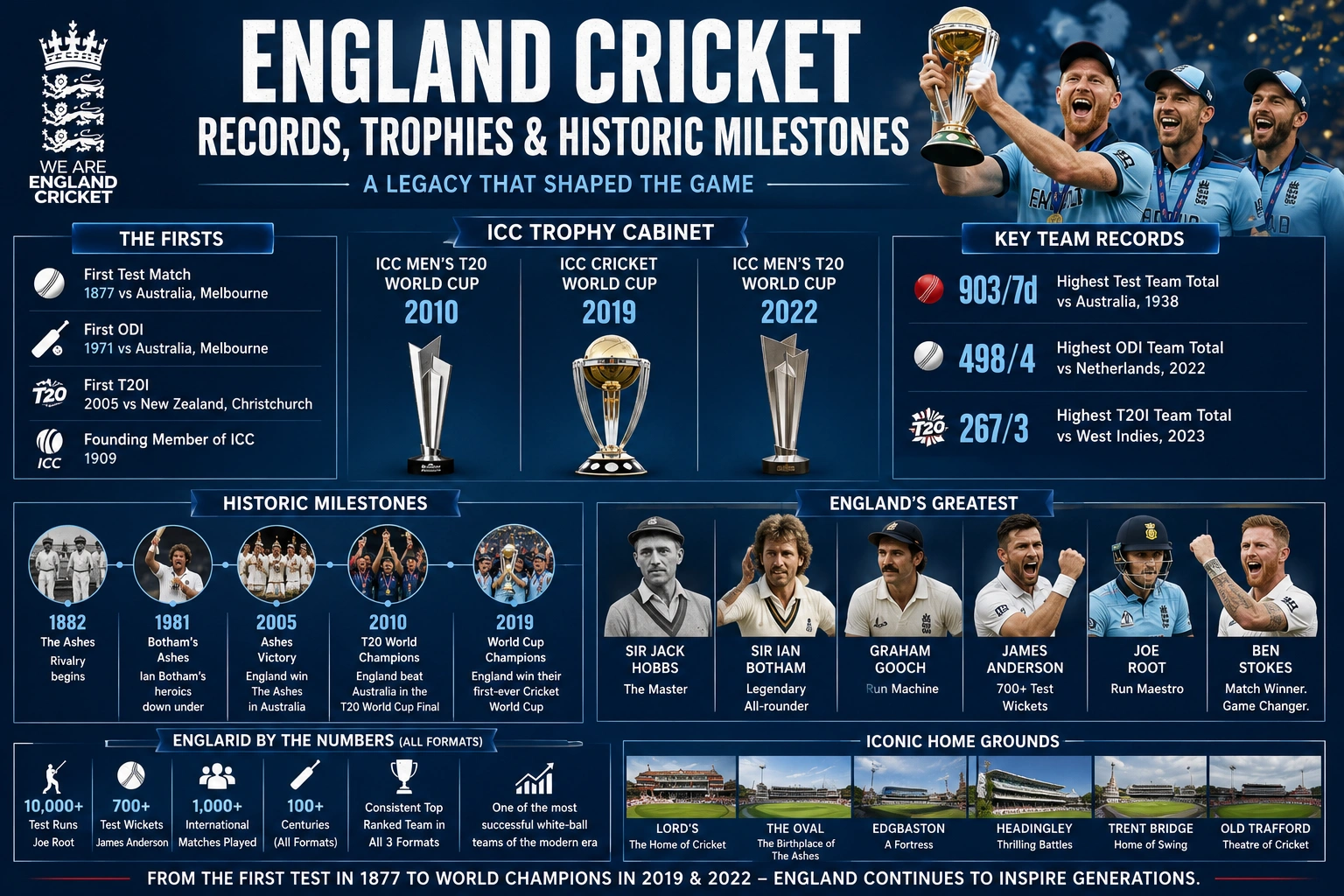
England’s Most Important Cricket Records
Some of England’s notable records include:
| Record | Achievement |
| First Test Match | 1877 vs Australia |
| First ODI | 1971 |
| First T20I | 2005 |
| ICC Cricket World Cup Titles | 1 (2019) |
| ICC Men’s T20 World Cup Titles | 2 (2010, 2022) |
| Highest Test Team Total | 903/7 declared vs Australia (1938) |
| Highest ODI Team Total | 498/4 vs Netherlands (2022) |
| Highest T20I Total | 267/3 vs West Indies (2023) |
These records reflect England’s transformation into one of cricket’s most aggressive batting teams during the white-ball era.
England’s Greatest Players Through History
Every successful cricket nation is defined by its icons. England has produced remarkable players across generations.
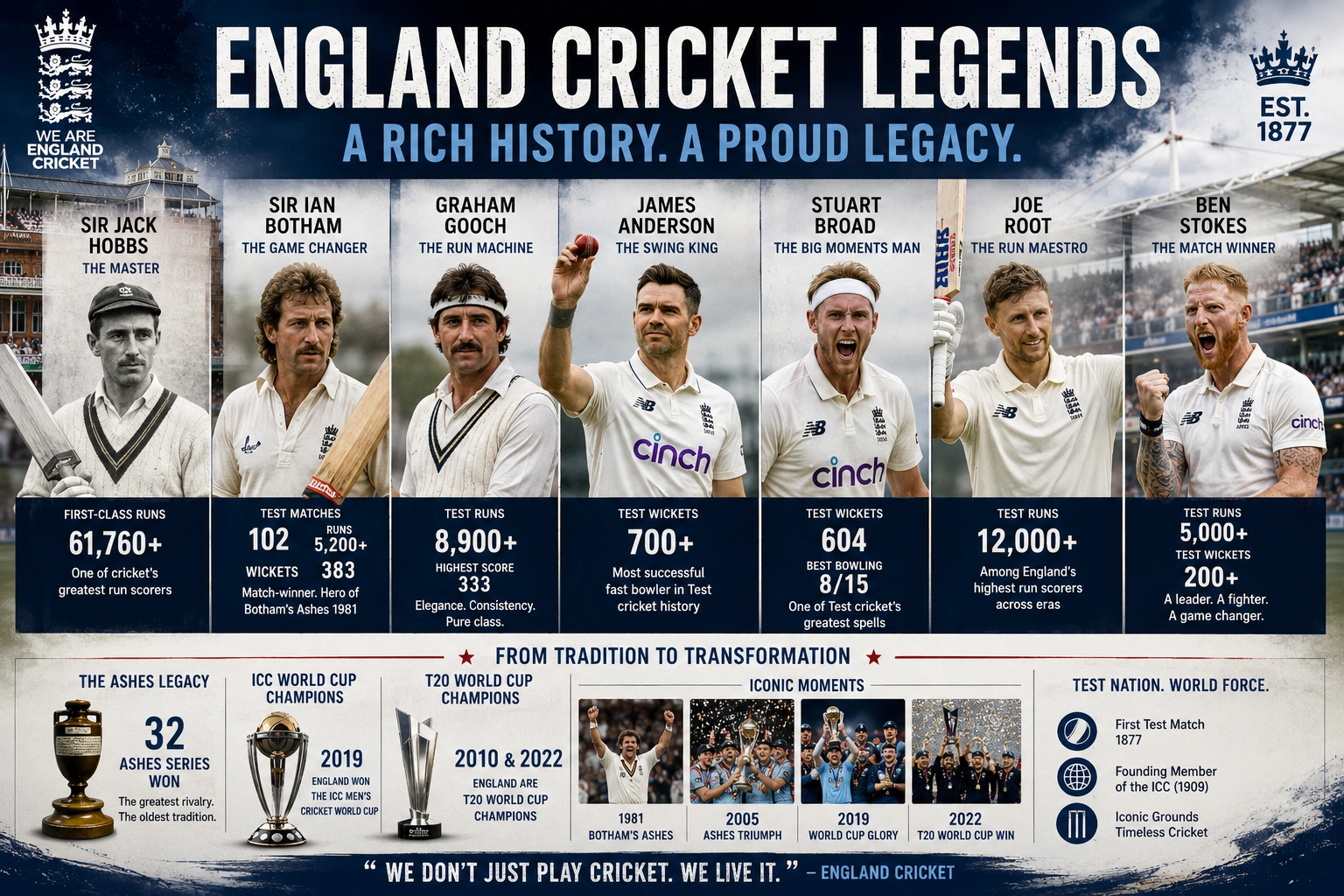
Sir Jack Hobbs
Often called “The Master,” Hobbs remains one of cricket’s greatest opening batters.
His first-class record of more than 61,000 runs still stands among the greatest achievements in cricket history.
Sir Ian Botham
Few cricketers have matched Botham’s influence.
An outstanding all-rounder, Botham inspired England to one of the most famous Ashes victories in 1981 with match-winning performances that changed cricket folklore forever.
Graham Gooch
Gooch dominated world cricket during the late 1980s and early 1990s.
His famous 333 against India remains one of England’s highest individual Test scores.
James Anderson
James Anderson redefined fast bowling longevity.
He became the first fast bowler to take 700 Test wickets, finishing with more than 700 Test wickets before retiring as England’s most successful bowler and one of cricket’s greatest seamers.
His mastery of swing bowling made him successful in every major cricketing nation.
Stuart Broad
Broad formed one of cricket’s greatest new-ball partnerships with Anderson.
His unforgettable spell of 8 wickets for 15 runs against Australia at Trent Bridge remains one of the finest bowling performances in modern Test cricket.
Joe Root
Joe Root ranks among England’s greatest batters.
Known for consistency across conditions, Root has accumulated thousands of Test runs while leading England through both difficult transitions and successful rebuilding phases.
Ben Stokes
Few modern cricketers symbolize England’s fighting spirit like Ben Stokes.
His innings at Headingley during the 2019 Ashes and his match-winning performance in the 2019 World Cup Final secured his place among England’s greatest-ever all-rounders.
As captain, Stokes also helped redefine England’s Test approach with an aggressive philosophy popularly known as “Bazball.”
England’s Evolution Across Cricket Formats
England’s identity has changed dramatically over time.
Test Cricket
Traditionally, England built success through disciplined batting, accurate seam bowling, and exploiting home conditions.
The arrival of Brendon McCullum as coach and Ben Stokes as captain introduced an attacking philosophy focused on positive intent, faster scoring, and entertaining cricket.
The strategy produced memorable victories while attracting worldwide attention.
One-Day Internationals
England struggled in ODI cricket for decades.
Everything changed after the disappointing 2015 Cricket World Cup, prompting a complete overhaul of selection philosophy and batting strategy.
Players such as Jason Roy, Jonny Bairstow, Jos Buttler, Ben Stokes, Eoin Morgan, and Moeen Ali transformed England into one of the world’s most explosive batting teams.
The reward came with the unforgettable 2019 World Cup triumph.
Twenty20 Cricket
England embraced franchise-style aggression earlier than many traditional cricket nations.
Their fearless batting, versatile all-rounders, and deep pace attack helped them win T20 World Cups in 2010 and 2022, cementing their reputation as a global white-ball powerhouse.
Iconic Home Grounds That Define England Cricket
England’s cricket culture is closely tied to its historic stadiums.
Lord’s, London
Known as the “Home of Cricket,” Lord’s has hosted countless historic Test matches and World Cup finals.
The Oval
The venue where the famous 1882 Ashes story began.
Edgbaston
One of England’s loudest and most intimidating cricket venues, especially during Ashes contests.
Headingley
Famous for producing thrilling Test finishes, including Ben Stokes’ unforgettable 135 against Australia in 2019.
Old Trafford
A traditional venue known for producing memorable Ashes encounters and outstanding bowling performances.
Trent Bridge
Recognized for swing-friendly conditions and several historic victories.
Why England Remains One of Cricket’s Most Influential Teams
England’s influence extends beyond trophies.
It helped establish organized international cricket, created many of the game’s traditions, pioneered county cricket as a talent pathway, and continues to innovate strategically.
The modern England team has also shown that traditional Test cricket and aggressive attacking cricket can coexist. Their willingness to evolve after setbacks—particularly following the 2015 World Cup—offers a case study in successful sporting transformation.
With emerging talents joining experienced stars, England remains a leading force across all formats and a team capable of shaping cricket’s future just as it shaped its past.
Frequently Asked Questions
When did England play its first international cricket match?
England played the first officially recognized Test match against Australia in Melbourne in March 1877. Although England lost the match by 45 runs, it marked the beginning of Test cricket.
How many ICC World Cups has England won?
England has won one ICC Cricket World Cup (2019) and two ICC Men’s T20 World Cups (2010 and 2022).
Who has taken the most Test wickets for England?
James Anderson is England’s leading Test wicket-taker, finishing his international career with more than 700 Test wickets—the most by any fast bowler in Test history.
Why is The Ashes so famous?
The Ashes began in 1882 after Australia’s victory over England at The Oval inspired a satirical newspaper obituary claiming English cricket had “died.” Since then, it has become cricket’s most celebrated bilateral rivalry.
Conclusion
The England national cricket team history is inseparable from the history of cricket itself. From playing the first Test match in 1877 to winning global ICC titles and redefining modern batting philosophies, England has continually influenced how the sport is played. While records and trophies tell part of the story, the team’s lasting legacy lies in its ability to evolve with every generation. For cricket fans, England’s journey remains one of the richest and most compelling narratives in international sport.
