


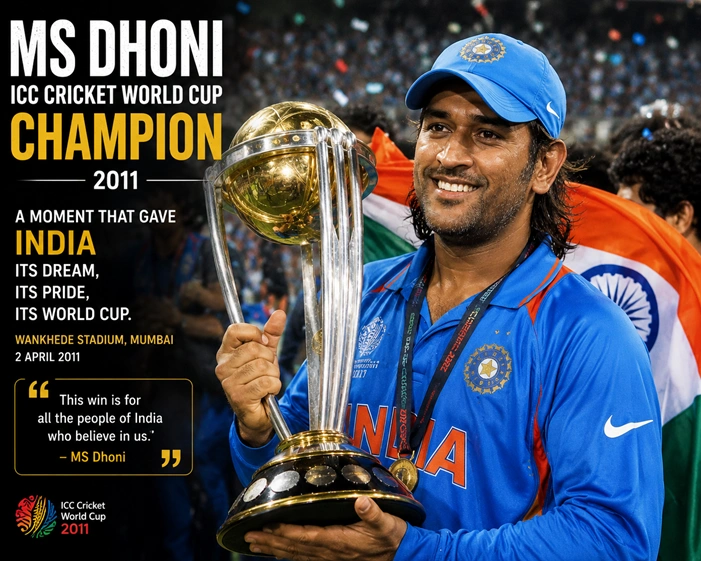
On the night of 2 April 2011, Mumbai’s Wankhede Stadium held its breath. India needed calm amid chaos. The scoreboard read 223 for 4. Millions expected Yuvraj Singh to walk in, but instead, a familiar figure emerged from the pavilion, bat tucked under his arm and expression unchanged. Mahendra Singh Dhoni, India’s captain, promoted himself ahead of the tournament’s most in-form batter.
No celebration. No dramatic gesture.
Just a quiet walk.
For nearly an hour, Dhoni absorbed pressure, rebuilt the chase with Gautam Gambhir, and then, with four runs needed to win, launched Nuwan Kulasekara high over long-on. Ravi Shastri’s immortal words—“Dhoni finishes off in style!”—became part of cricket’s folklore.
The six won India its first ODI World Cup in 28 years, but it also captured the essence of the man behind the moment. Dhoni never chased headlines. He chased decisions. While others reacted emotionally, he calculated. While crowds demanded urgency, he trusted timing.
That philosophy shaped one of cricket’s most remarkable careers. From a railway ticket examiner in Ranchi to lifting every major ICC trophy available to a captain, Dhoni’s story is not merely about talent. It is about patience, resilience, calculated risk, and the rare ability to remain composed when everyone else loses theirs.
More than two decades after making his professional debut, the MS Dhoni biography continues to inspire aspiring cricketers, leaders, and sports fans across the world.
Quick Facts About MS Dhoni
- Full Name: Mahendra Singh Dhoni
- Nickname: Mahi, Captain Cool, Thala
- Born: 7 July 1981
- Birthplace: Ranchi, Jharkhand (then Bihar), India
- Height: 5 ft 9 in (175 cm)
- Role: Wicketkeeper-Batter
- Batting Style: Right-handed
- Bowling Style: Right-arm medium (occasional)
- International Debut: ODI vs Bangladesh (23 December 2004)
- Test Debut: vs Sri Lanka (2 December 2005)
- T20I Debut: vs South Africa (1 December 2006)
- IPL Team: Chennai Super Kings
- Jersey Number: 7
- ICC Titles as Captain: T20 World Cup (2007), ODI World Cup (2011), Champions Trophy (2013)
Early Life & Family Background
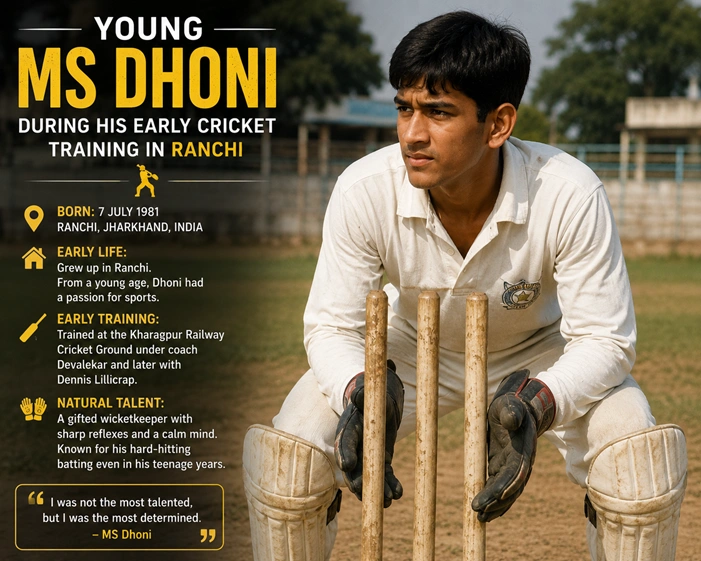
Long before packed stadiums echoed his name, Mahendra Singh Dhoni lived a simple life in Ranchi, a city that had little connection with India’s cricketing mainstream during the 1980s and 1990s. There were no elite academies, no glamorous cricketing culture, and certainly no obvious pathway to international fame.
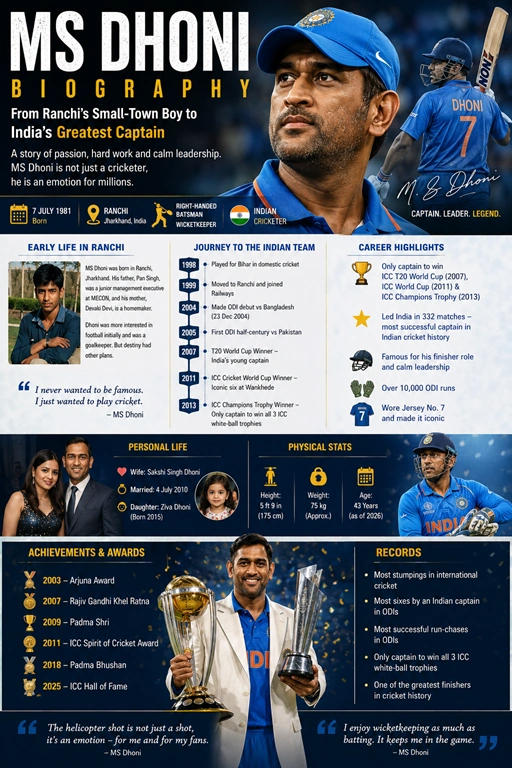
Born on 7 July 1981, Dhoni was the youngest child of Pan Singh and Devaki Devi. His father worked with MECON, a public sector engineering company, while his mother managed the household. The family originally hailed from Lwali village in Uttarakhand’s Almora district before relocating to Ranchi in search of better employment opportunities.
Growing up in a middle-class household meant discipline came before dreams. Cricket equipment was expensive, coaching opportunities were limited, and every career decision carried practical consequences. Yet Dhoni’s parents quietly supported their son’s sporting interests, even when success seemed uncertain.
Ironically, cricket was not his first love.
As a schoolboy at DAV Jawahar Vidya Mandir, Dhoni excelled as a football goalkeeper. His quick reflexes impressed his physical education teacher, who suggested that he fill in as wicketkeeper for the school cricket team. That unexpected decision altered Indian cricket history.
The transition looked natural. His athleticism, anticipation, and fearless attitude behind the stumps immediately stood out. Unlike many youngsters trained from childhood, Dhoni developed unconventional techniques. Those very techniques would later become his trademark.
Outside sports, he enjoyed badminton, football, and motorcycles—passions that remain part of his personality today. Friends from his childhood often recall him as quiet, humorous, and fiercely competitive without seeking attention.
His journey reminds aspiring cricketers that greatness does not always emerge from famous cricket academies. Sometimes it begins on dusty grounds where imagination compensates for limited facilities.
Did You Know?
Before becoming India’s wicketkeeper, Dhoni was considered one of the best football goalkeepers in his school. His quick hands and lightning-fast reflexes on the football field later became the foundation of his exceptional wicketkeeping skills.
Rise Through Domestic Cricket
The road to international cricket was anything but straightforward.
Unlike many Indian stars who dominated age-group cricket from an early age, Dhoni progressed steadily through domestic competitions. His performances often went unnoticed outside eastern India, but selectors within Bihar’s cricket circuit recognized his natural power and fearless batting.
He made his first-class debut for Bihar during the 1999–2000 Ranji Trophy, scoring an unbeaten 68 in his maiden innings. It wasn’t a headline-making debut, but it showcased two qualities that would define his career—composure and finishing ability.
Following the creation of Jharkhand in 2000, Dhoni represented the new state in domestic cricket. His aggressive batting style contrasted sharply with the traditional approach of Indian wicketkeepers, who were primarily selected for their glovework.
A significant turning point arrived when he was selected for the India A tour of Kenya and Zimbabwe in 2004.
Facing strong bowling attacks featuring international stars, Dhoni announced himself with authority. He scored heavily against Pakistan A, including a blistering century that caught the attention of national selectors.
Former India captain Sourav Ganguly, then leading the national side, reportedly admired Dhoni’s fearless approach and backed his selection.
Around the same period, Dhoni balanced cricket with an ordinary government job as a Travelling Ticket Examiner (TTE) for the Indian Railways at Kharagpur Railway Station in West Bengal.
Colleagues remember him working night shifts before returning to cricket practice. The stability of a government job offered security, but the dream of wearing India’s blue jersey remained stronger.
By late 2004, opportunity knocked.
Lesser-Known Fact
During his days as a railway ticket examiner, Dhoni became famous among colleagues for his sense of humor. Former co-workers have shared stories of playful pranks during night shifts, making him one of the most popular employees at Kharagpur station.
International Career Timeline (2004–2011): From Raw Talent to World Champion
If Dhoni’s domestic journey was gradual, his international rise was anything but.
He made his One-Day International debut against Bangladesh on 23 December 2004 in Chattogram. Expectations were high, but reality proved harsh. Attempting a quick single, Dhoni was run out for 0.
Many careers have stalled after such beginnings.
His did not.
2005: The Arrival
In April 2005, India faced Pakistan in Visakhapatnam.
Promoted to No. 3, Dhoni unleashed an astonishing innings of 148 from just 123 balls, then the highest score by an Indian wicketkeeper in ODIs. His long hair, explosive strokeplay, and fearless hitting made him an overnight sensation.
Only months later, he surpassed even that performance by smashing 183 not out against Sri Lanka in Jaipur, still one of the greatest ODI innings ever played by a wicketkeeper. Chasing 299, Dhoni dismantled a quality Sri Lankan attack with effortless six-hitting and precise running between the wickets.
The innings remains the highest individual ODI score by a wicketkeeper in a successful run chase.
2006–2007: Taking Charge
Dhoni made his Test debut against Sri Lanka in December 2005 and gradually established himself across all three formats.
In September 2007, following India’s disappointing ODI World Cup campaign, selectors made a bold decision. At just 26 years old, Dhoni was appointed captain for the inaugural ICC World Twenty20 in South Africa.
Many experts viewed India as outsiders.
Instead, Dhoni’s calm leadership transformed a young squad featuring Rohit Sharma, Gautam Gambhir, Robin Uthappa, Irfan Pathan, RP Singh, and a young pace attack into world champions.
The unforgettable final against Pakistan ended with Dhoni handing the last over to Joginder Sharma instead of the experienced Harbhajan Singh—a gamble that succeeded when Misbah-ul-Haq miscued the famous scoop into Sreesanth’s hands.
That single decision announced a new leadership philosophy: trust instinct over convention.
2008–2010: Building a New India
Dhoni’s captaincy extended beyond trophies.
He nurtured a generation of future stars including Virat Kohli, Ravindra Jadeja, Ravichandran Ashwin, and Suresh Raina while maintaining India’s rise to the No. 1 Test ranking in 2009.
His tactical flexibility, confidence in young players, and ability to absorb pressure reshaped India’s cricketing culture.
2011: The Night That Defined a Generation
Few cricketing images rival Dhoni’s winning six at Wankhede Stadium.
Throughout the tournament, he struggled with the bat. Critics questioned his form. Yet in the final against Sri Lanka, he made perhaps the boldest tactical call of his career by promoting himself above Yuvraj Singh to counter the off-spin of Muttiah Muralitharan.
The gamble paid off magnificently.
His unbeaten 91 from 79 balls guided India to a six-wicket victory, ending a 28-year wait for the ODI World Cup.
It wasn’t merely an innings.
It became one of cricket’s defining moments—a captain assuming responsibility when it mattered most.
International Career Timeline (2012–2026): Reinvention, Leadership and the Chennai Legacy
The 2011 World Cup cemented Mahendra Singh Dhoni’s place among cricket’s greats, but his story did not end with the famous six at Wankhede. If the first phase of his career was about explosive batting and fearless leadership, the next was about adaptation. Dhoni evolved from an aggressive match-winner into a master strategist who influenced games through captaincy, wicketkeeping, and calculated finishing.
2012–2013: Completing Cricket’s Grand Slam
India endured a difficult overseas period in England and Australia, but Dhoni remained the team’s central figure. In home conditions, he responded emphatically.
During the 2013 Border-Gavaskar Trophy against Australia, he produced one of the finest innings of his Test career. At Chennai, he scored 224, his highest Test score, displaying patience rarely associated with his limited-overs batting. It remains the highest Test score by an Indian wicketkeeper.
Later that year came another historic achievement.
At the ICC Champions Trophy 2013 in England, India went unbeaten throughout the tournament. In a rain-shortened final at Edgbaston against England, Dhoni’s tactical brilliance helped defend just 129 runs in 20 overs, securing victory by five runs.
With that triumph, Dhoni became the first captain in international cricket to win all three major ICC white-ball trophies:
- ICC World Twenty20 (2007)
- ICC Cricket World Cup (2011)
- ICC Champions Trophy (2013)
No captain has matched that achievement.
2014: A Quiet Goodbye to Test Cricket
December 2014 brought one of Indian cricket’s biggest surprises.
After the third Test against Australia in Melbourne, Dhoni announced his retirement from Test cricket with immediate effect.
There were no elaborate farewell speeches or emotional ceremonies.
He simply stepped away.
His Test career ended with:
- 90 Tests
- 4,876 runs
- 38.09 batting average
- 6 centuries
- 294 dismissals as wicketkeeper
Virat Kohli succeeded him as India’s Test captain, while Dhoni continued leading the ODI and T20I teams.
2015–2017: Passing the Torch
India reached the semifinals of the 2015 ODI World Cup, losing to eventual champions Australia.
Though critics began questioning Dhoni’s batting strike rate in chases, his wicketkeeping remained unmatched. His lightning-fast stumpings, anticipation, and ability to read batters continued to save crucial runs.
In January 2017, Dhoni voluntarily stepped down as India’s limited-overs captain.
Rather than holding onto leadership, he chose to support the next generation.
Virat Kohli became India’s new captain, while Dhoni embraced the role of senior mentor, helping young players navigate international cricket.
2018–2019: One Last World Cup
The 2019 ICC Cricket World Cup in England was expected to be Dhoni’s final appearance on cricket’s biggest stage.
He contributed valuable innings during the tournament, but the semifinal against New Zealand ended heartbreakingly.
Chasing 240 at Old Trafford, India collapsed early before Ravindra Jadeja and Dhoni revived hopes.
With India still needing runs, Dhoni attempted a second run but was brilliantly run out by Martin Guptill.
As he walked back with his head bowed, millions suspected they had witnessed his final international innings.
They were right.
15 August 2020: Farewell Without Fanfare
At 7:29 PM IST on India’s Independence Day, Dhoni announced his retirement from international cricket through a short Instagram video accompanied by the song “Main Pal Do Pal Ka Shayar Hoon.”
The message read simply:
“Thanks a lot for your love and support throughout. From 1929 hrs consider me as retired.”
There was no press conference.
No farewell series.
No stadium packed with speeches.
The understated announcement reflected the personality that had defined his entire career.
The Chennai Super Kings Era: More Than a Franchise
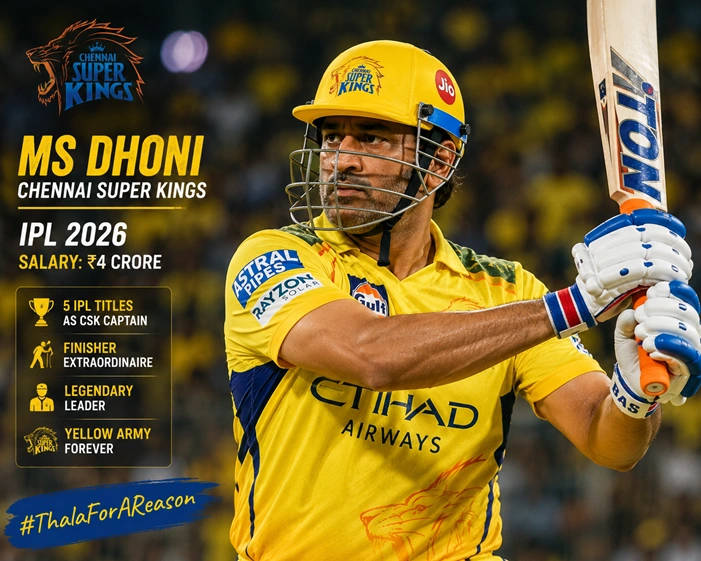
While Dhoni retired from international cricket, his journey with the Chennai Super Kings (CSK) continued.
For Chennai supporters, he became much more than a captain.
He became “Thala”—the leader.
Since joining CSK in the inaugural IPL season in 2008, Dhoni has built one of the most successful franchise dynasties in world cricket.
Under his leadership, Chennai has won multiple IPL titles and consistently qualified for the playoffs, creating a culture based on trust, stability, and experience.
His influence extends beyond tactics.
Young players frequently credit Dhoni with simplifying the game, removing fear of failure, and encouraging clarity under pressure.
Even opposition captains have acknowledged seeking his advice during tournaments.
IPL 2021–2025: Defying Time
Many expected Dhoni’s influence to decline with age.
Instead, he adapted.
Rather than batting long innings, he focused on finishing matches, guiding bowlers, and controlling field placements.
His wicketkeeping remained among the quickest in the league despite being in his forties.
Highlights include:
- IPL Champion (2021)
- IPL Champion (2023)
- Continued leadership and mentoring role through the mid-2020s
- Massive fan following across India and overseas
Every time he walked onto the field at Chepauk Stadium, thousands of supporters stood before he even faced a ball.
MS Dhoni Height in Feet
How Tall Is MS Dhoni?
MS Dhoni stands 5 feet 9 inches (175 cm) tall.
While he is not among the tallest wicketkeepers in world cricket, his athletic build, exceptional balance, and explosive lower-body strength have been key to his success behind the stumps.
Physical Profile
| Attribute | Details |
|---|---|
| Height | 5 ft 9 in (175 cm) |
| Weight | Approximately 75 kg [may vary seasonally] |
| Eye Colour | Dark Brown |
| Hair Colour | Black (occasionally dyed) |
| Batting Style | Right-handed |
| Bowling Style | Right-arm medium (occasional) |
| Role | Wicketkeeper-Batter |
Jersey Number 7 & the Story Behind It
Few jersey numbers in Indian sport are as recognizable as No. 7.
For Dhoni, the number carries personal significance rather than marketing value.
He was born on 7 July 1981, making the number seven a natural choice.
Over time, it became synonymous with calm leadership, finishing matches, and remarkable consistency under pressure.
Interestingly, Dhoni has rarely spoken about superstition surrounding the number.
Instead, he has explained that it simply reflects his birth date.
Today, No. 7 is one of the most iconic jerseys in cricket history, instantly associated with his legacy.
Playing Style, Strengths & Signature Skills
Dhoni challenged almost every traditional coaching manual.
His batting technique looked unconventional.
His wicketkeeping was unconventional.
Even his captaincy ignored accepted norms.
Yet it worked.
A Finisher Like Few Others
Dhoni’s greatest batting strength was understanding match situations.
Rather than chasing personal milestones, he preferred taking games deep.
He often absorbed pressure early before accelerating in the final overs.
His remarkable ability to calculate required run rates made him one of ODI cricket’s finest finishers.
The Helicopter Shot
No discussion of Dhoni is complete without the Helicopter Shot.
Developed through years of playing tennis-ball cricket and refined alongside childhood friend Santosh Lal, the stroke relied on extraordinary wrist strength.
Instead of following conventional batting mechanics, Dhoni whipped full-length deliveries over midwicket with astonishing power.
It became his trademark stroke.
Lightning-Fast Wicketkeeping
Dhoni redefined wicketkeeping in limited-overs cricket.
His strengths included:
- Minimal backlift while collecting the ball
- Lightning-fast stumpings
- Sharp anticipation against spinners
- Excellent review recommendations (earning the nickname “DRS = Dhoni Review System” among fans)
- Calm communication with bowlers
Several stumpings were completed in less than three-tenths of a second after collecting the ball, highlighting his extraordinary reflexes.
Leadership Under Pressure
Perhaps Dhoni’s greatest cricketing skill was invisible.
Decision-making.
Whether promoting himself in the 2011 World Cup final, giving Joginder Sharma the final over in the 2007 T20 World Cup final, or trusting inexperienced bowlers in IPL finals, Dhoni repeatedly made bold calls without showing visible emotion.
Former teammates have often spoken about his ability to simplify high-pressure situations.
Career Statistics
Note: Career statistics below reflect completed international and major franchise records available up to August 2026. Verify against the latest official records before publication if newer matches are included.
International Career Stats
| Format | Matches | Runs | Batting Average | Strike Rate | Highest Score | 100s | 50s | Dismissals |
|---|---|---|---|---|---|---|---|---|
| Test | 90 | 4,876 | 38.09 | 59.11 | 224 | 6 | 33 | 294 |
| ODI | 350 | 10,773 | 50.57 | 87.56 | 183* | 10 | 73 | 444 |
| T20I | 98 | 1,617 | 37.60 | 126.13 | 56 | 0 | 2 | 91 |
Indian Premier League (IPL)
| Category | Record |
|---|---|
| IPL Debut | 2008 |
| Team | Chennai Super Kings |
| Matches | – |
| Runs | – |
| Batting Average | – |
| Strike Rate | – |
| Half-centuries | – |
| Catches | – |
| Stumpings | – |
| IPL Titles as Captain | 5 (2010, 2011, 2018, 2021, 2023) |
Other T20 Leagues
| League | Team | Highlights |
|---|---|---|
| Champions League T20 | Chennai Super Kings | Multiple title-winning campaigns |
| Other Overseas T20 Leagues | Did Not Participate | Dhoni chose not to play overseas franchise leagues after international retirement |
Personal Life & Fitness Journey
Despite a demanding career, Dhoni has remained one of cricket’s fittest athletes.
His training philosophy focuses on:
- Functional strength
- Sprint work
- Agility drills
- Core stability
- Long motorcycle rides and active outdoor lifestyle
Unlike many modern athletes, Dhoni has often relied on simple, consistent routines rather than highly publicized fitness programs.
Health & Fitness Table
| Injury/Health Event | Year | Impact | Recovery/Outcome |
|---|---|---|---|
| Recurring back stiffness | Multiple seasons | Managed workload | Continued playing successfully |
| Knee discomfort requiring surgery | 2023 | Limited movement during IPL | Successfully underwent surgery and returned for subsequent seasons |
| General workload management | Throughout career | Reduced physical strain | Maintained longevity into his 40s |
Family
Although one of the world’s most recognizable cricketers, Dhoni has kept his personal life remarkably private.
He married Sakshi Singh Rawat on 4 July 2010, just days after India’s tour of Zimbabwe.
The couple welcomed their daughter Ziva Dhoni in 2015.
Dhoni frequently prioritizes family time away from cricket, particularly at his farmhouse near Ranchi, where he spends time farming, caring for pets, and riding motorcycles.
Family Table
| Relation | Name | Detail |
|---|---|---|
| Father | Pan Singh | Former MECON employee |
| Mother | Devaki Devi | Homemaker |
| Brother | Narendra Singh Dhoni | Politician and businessman |
| Sister | Jayanti Gupta | School teacher |
| Wife | Sakshi Singh Dhoni | Entrepreneur |
| Daughter | Ziva Singh Dhoni | Born in 2015 |
Did You Know?
Despite earning millions during his cricket career, Dhoni remains deeply connected to his hometown of Ranchi. In retirement, he has spent considerable time managing agricultural activities at his farmhouse, where he has experimented with organic farming and dairy production alongside his long-standing passion for motorcycles.
Records & Achievements
MS Dhoni’s legacy is defined not just by trophies, but by how he won them. He transformed Indian cricket with calm leadership, tactical innovation, and an unwavering belief in backing players during high-pressure moments. His achievements span international cricket, the IPL, and captaincy records that continue to shape discussions about cricket’s greatest leaders.
Records & Achievements Table
| Achievement | Record/Details | Year |
|---|---|---|
| ICC Men’s T20 World Cup Winner (Captain) | Defeated Pakistan in inaugural final | 2007 |
| ICC Cricket World Cup Winner (Captain) | Defeated Sri Lanka at Wankhede Stadium | 2011 |
| ICC Champions Trophy Winner (Captain) | Defeated England in final | 2013 |
| No. 1 ICC Test Team (Captain) | India reached the top of Test rankings | 2009 |
| First Captain to Win All Three ICC White-Ball Trophies | T20 World Cup, ODI World Cup, Champions Trophy | 2013 |
| Highest ODI Score by an Indian Wicketkeeper | 183* vs Sri Lanka, Jaipur | 2005 |
| Highest Test Score | 224 vs Australia, Chennai | 2013 |
| Most International Stumpings | Among the highest in cricket history | Career |
| IPL Titles as Captain | Chennai Super Kings | 2010, 2011, 2018, 2021, 2023 |
| Padma Shri | Government of India | 2009 |
| Rajiv Gandhi Khel Ratna (now Major Dhyan Chand Khel Ratna) | India’s highest sporting honour | 2007 |
| Padma Bhushan | Government of India | 2018 |
| ICC ODI Player of the Year | Winner | 2008, 2009 |
| Honorary Lieutenant Colonel | Indian Territorial Army | 2011 |
Controversies & Challenges Faced
Few careers spanning nearly two decades are entirely free from criticism. Dhoni’s journey included difficult phases, but most debates centered on cricketing decisions rather than disciplinary issues.
1. Batting Position Debates
During the latter stages of his ODI career, Dhoni was often criticized for batting lower in the order or taking games deep. Supporters viewed it as calculated finishing, while critics argued that it occasionally increased pressure on the remaining batters.
2. Overseas Test Results
Although India achieved the No. 1 Test ranking under Dhoni’s captaincy, overseas tours to England (2011–12) and Australia (2011–12) were disappointing. Questions were raised about tactics, team balance, and transition planning. Dhoni acknowledged the challenges and continued rebuilding the side with younger players.
3. Retirement Timing
Dhoni’s retirement from Test cricket in 2014 and international cricket in 2020 surprised many. Some fans hoped for a farewell series, but his understated exits reflected the low-profile approach he maintained throughout his career.
4. IPL Spot-Fixing Era
During the 2013 IPL spot-fixing and betting controversy, Chennai Super Kings’ team management came under intense scrutiny. Dhoni himself was never found guilty of wrongdoing, and no disciplinary action was taken against him. His role remained that of captain on the field while investigations focused on administrative matters.
Legacy & Current Status (As of 7 August 2026)
Few athletes have influenced Indian sport as profoundly as MS Dhoni.
His numbers alone tell an extraordinary story—more than 10,000 ODI runs, multiple ICC trophies, five IPL titles as captain, and countless memorable finishes. Yet statistics capture only part of his impact.
Dhoni changed how India viewed leadership. He showed that calmness could be a competitive advantage, that instinct could coexist with analysis, and that trust in young players often produced long-term success.
His mentorship shaped the careers of cricketers such as Virat Kohli, Ravindra Jadeja, Ravichandran Ashwin, Rohit Sharma, and Suresh Raina, among many others. Even after retiring from international cricket, his influence remained visible through the Chennai Super Kings dressing room, where younger players frequently credited him for simplifying pressure situations.
Off the field, Dhoni continues to divide his time between Ranchi and Chennai. He has pursued interests in farming, business ventures, motorcycle collecting, and mentoring emerging talent while remaining one of the most admired figures in world cricket.
Whether or not he continues playing in future IPL seasons beyond 2026 remains a decision only he can make. Regardless of that choice, his place in cricket history is secure.
For millions of fans, “Captain Cool” is more than a nickname—it represents a philosophy of composure under pressure.
Did You Know?
MS Dhoni became the first Indian wicketkeeper to score over 10,000 ODI runs, combining elite wicketkeeping with one of the most successful batting careers ever achieved by a player in his role.
Frequently Asked Questions (FAQs)
1. Who is MS Dhoni?
MS Dhoni, whose full name is Mahendra Singh Dhoni, is a former Indian international cricketer, wicketkeeper-batter, and one of the country’s most successful captains. He led India to victories in the 2007 ICC T20 World Cup, the 2011 Cricket World Cup, and the 2013 Champions Trophy.
2. How tall is MS Dhoni?
MS Dhoni is 5 feet 9 inches (175 cm) tall. His athletic build, quick reflexes, and exceptional balance contributed significantly to his success as one of cricket’s finest wicketkeepers.
3. Why does MS Dhoni wear jersey number 7?
Dhoni wears jersey number 7 because he was born on 7 July 1981. He has stated that the number is personally meaningful rather than being linked to superstition.
4. When did MS Dhoni retire from international cricket?
MS Dhoni announced his retirement from all international cricket on 15 August 2020 through a brief social media post. He continued playing franchise cricket in the Indian Premier League after his international retirement.
5. How many ICC trophies has MS Dhoni won as captain?
Dhoni won three major ICC tournaments as India’s captain:
- ICC World Twenty20 (2007)
- ICC Cricket World Cup (2011)
- ICC Champions Trophy (2013)
He remains the only captain to achieve this unique treble.
6. Who is MS Dhoni’s wife?
MS Dhoni married Sakshi Singh Dhoni (née Rawat) on 4 July 2010. The couple has one daughter, Ziva Singh Dhoni, born in 2015.
7. Why is MS Dhoni called “Captain Cool”?
Dhoni earned the nickname “Captain Cool” because of his ability to remain calm during high-pressure matches. His composed decision-making, measured body language, and tactical confidence became defining characteristics of his captaincy.
Quiz: Test Your Knowledge About MS Dhoni
Tick the correct answer.
- MS Dhoni was born in:
- ☐ Mumbai
- ☑ Ranchi
- ☐ Chennai
- ☐ Delhi
- Dhoni made his ODI debut against:
- ☐ Pakistan
- ☑ Bangladesh
- ☐ Sri Lanka
- ☐ England
- Dhoni’s jersey number is:
- ☐ 10
- ☑ 7
- ☐ 18
- ☐ 45
- Dhoni’s highest ODI score is:
- ☐ 148
- ☑ 183*
- ☐ 224
- ☐ 175
- India won the 2011 World Cup by defeating:
- ☐ Australia
- ☐ Pakistan
- ☑ Sri Lanka
- ☐ England
- Dhoni’s IPL team is:
- ☐ Mumbai Indians
- ☑ Chennai Super Kings
- ☐ Rajasthan Royals
- ☐ Sunrisers Hyderabad
- Dhoni’s batting style is:
- ☐ Left-handed
- ☑ Right-handed
- ☐ Switch hitter
- ☐ Ambidextrous
- Dhoni’s nickname is:
- ☐ Hitman
- ☑ Captain Cool
- ☐ Wall
- ☐ Turbanator
- Dhoni captained India to the T20 World Cup in:
- ☐ 2009
- ☑ 2007
- ☐ 2010
- ☐ 2012
- Dhoni retired from international cricket in:
- ☐ 2018
- ☐ 2019
- ☑ 2020
- ☐ 2021
- Dhoni’s highest Test score is:
- ☐ 183*
- ☑ 224
- ☐ 148
- ☐ 201
- Dhoni played as:
- ☐ Fast bowler
- ☐ Spinner
- ☑ Wicketkeeper-batter
- ☐ Opening batter
- Dhoni’s wife is:
- ☐ Anushka Sharma
- ☑ Sakshi Singh Dhoni
- ☐ Ritika Sajdeh
- ☐ Sanjana Ganesan
- Dhoni received the Padma Bhushan in:
- ☐ 2013
- ☐ 2015
- ☑ 2018
- ☐ 2020
- Dhoni worked as a:
- ☐ Banker
- ☑ Railway Ticket Examiner
- ☐ Police Officer
- ☐ Teacher
- Dhoni’s famous batting stroke is:
- ☐ Reverse Sweep
- ☑ Helicopter Shot
- ☐ Switch Hit
- ☐ Ramp Shot
- India became No. 1 in Test cricket under Dhoni in:
- ☐ 2007
- ☐ 2008
- ☑ 2009
- ☐ 2011
- Dhoni’s daughter is named:
- ☐ Aaradhya
- ☐ Vamika
- ☑ Ziva
- ☐ Samaira
- Dhoni’s birthplace is in:
- ☐ Maharashtra
- ☑ Jharkhand
- ☐ Karnataka
- ☐ Punjab
- Dhoni is popularly called by CSK fans:
- ☐ King
- ☑ Thala
- ☐ Boss
- ☐ Master
