


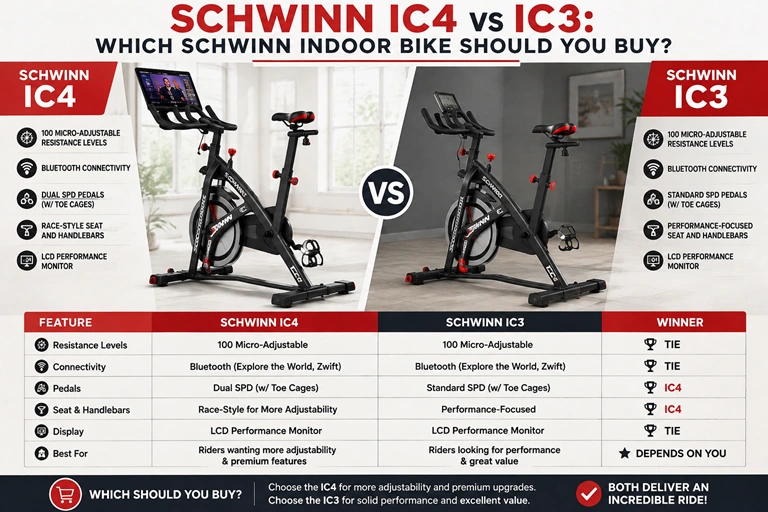
Choosing between two bikes from the same brand sounds easy until you look closely at the features. The Schwinn IC4 vs IC3 decision comes down to more than price: the IC4 adds magnetic resistance, app connectivity, USB charging, a heart-rate armband and a higher user-weight limit, while the IC3 keeps things simpler with a 40-pound flywheel and friction resistance. So, which one makes more sense for your home gym? The answer depends heavily on how you plan to train.
Quick Summary
- Best overall: Schwinn IC4
- Best for a lower upfront price: Schwinn IC3
- Best for Peloton/Zwift/JRNY users: Schwinn IC4
- Best for simple, no-frills cycling: Schwinn IC3
- Better resistance system: IC4 magnetic resistance
- Higher maximum user weight: IC4 at 330 pounds vs. IC3 at 300 pounds
- Longer warranty: IC4
- Current listed prices: IC4 $899 and IC3 $699 on Schwinn’s U.S. site at the time of research.
Schwinn IC4 vs IC3: What Is the Difference?
At first glance, the IC4 and IC3 share a surprisingly similar physical design. Both are indoor cycling bikes with race-style seats, adjustable handlebars, dual-sided pedals, tablet holders and workout consoles. Both are designed around traditional spin-bike riding rather than the large touchscreen experience found on premium connected bikes.
The biggest difference is what happens underneath that familiar frame.
The IC4 uses 100 levels of magnetic resistance, while the IC3 uses an infinitely variable felt-pad resistance system paired with a 40-pound perimeter-weighted flywheel. The IC4 is also designed to connect with training platforms including JRNY, Peloton and Zwift, whereas Schwinn lists the IC3 as having no training-app connectivity.
That distinction matters if you want an interactive workout experience. If you simply want to get on the bike, turn the resistance knob and ride, the IC3 can still make a lot of sense.
Schwinn IC4 vs IC3 specifications
| Feature | Schwinn IC4 | Schwinn IC3 |
|---|---|---|
| Listed U.S. price | $899 | $699 |
| Resistance | 100 magnetic levels | Infinite felt-pad resistance |
| Drive/resistance style | Magnetic | Friction |
| App connectivity | JRNY, Peloton, Zwift and others | No training-app connectivity |
| Display | Full-color LCD | LCD |
| Heart-rate support | Bluetooth HR armband included | Compatible with select wireless monitors; strap not included |
| USB charging | Yes | No |
| Dumbbells | Two 3-lb. dumbbells included | No |
| Pedals | SPD clips + toe cages | SPD clips + toe cages |
| Tablet holder | Yes | Yes |
| Maximum user weight | 330 lbs | 300 lbs |
| Assembled weight | 113.6 lbs | 103 lbs |
| Dimensions | 54.6 × 30.7 × 51.8 in. | 54.6 × 30.7 × 49.8 in. |
| Power | Wall adapter | 2 AA batteries |
| Frame warranty | 10 years | 5 years |
Specifications and current listed pricing are based on Schwinn’s official product and comparison pages and can change over time.
How Does the Resistance Compare?
Resistance is probably the most important difference between these two bikes because it changes the feel of every workout.
Schwinn IC4 magnetic resistance
The IC4 has 100 levels of magnetic resistance. Instead of a felt pad physically pressing against the flywheel, magnetic resistance changes the riding challenge without direct friction against the flywheel. Schwinn describes the system as smooth and quiet.
For someone following structured cycling classes, this is a significant advantage. You can make small adjustments rather than making large changes between easy and difficult efforts.
The IC4’s resistance system is also part of why it is better suited to users who want a more connected training setup. Schwinn lists compatibility with Peloton, Zwift and JRNY, although separate digital subscriptions may be required for those services.
Schwinn IC3 friction resistance
The IC3 takes a more traditional approach. It uses a 40-pound perimeter-weighted flywheel with infinitely variable felt-pad resistance. That setup is straightforward and familiar to anyone who has used a conventional spin bike.
There is nothing inherently wrong with friction resistance. In fact, some riders may prefer the simplicity. But it does not offer the same connected-training experience as the IC4.
Winner: Schwinn IC4
For smoother adjustments and modern connected workouts, the IC4 gets the advantage.
Which Bike Is Better for Peloton, Zwift and Connected Workouts?
This is where the comparison becomes much easier.
If your plan is to put a tablet on the bike and follow Peloton, Zwift or JRNY workouts, the IC4 is the obvious choice. Schwinn specifically lists those platforms among the IC4’s compatible training apps. It also has Bluetooth connectivity and a supplied Bluetooth heart-rate armband.
The IC3 is fundamentally more basic. Schwinn’s comparison page lists the IC3 as having no training-app connectivity. It does have a device holder, so you can still watch videos or follow a workout displayed on a tablet, but the bike itself does not provide the same connected functionality.
There’s an important distinction here: a tablet holder isn’t the same thing as app integration.
With the IC3, your tablet can display a workout, but the bike does not provide the same level of communication with supported training platforms. If interactive training is a major reason you’re buying an indoor bike, paying more for the IC4 is easier to justify.
Winner: Schwinn IC4
What About Comfort, Fit and Everyday Use?
The two bikes are closer than you might expect in this area.
Both have race-style seats and four-way adjustable handlebars, along with dual-sided pedals that offer SPD clips on one side and toe cages on the other. That means riders can use compatible cycling shoes or ordinary athletic shoes.
The bikes also have the same listed length and width: 54.6 inches long and 30.7 inches wide. The IC4 is slightly taller at 51.8 inches, compared with 49.8 inches for the IC3.
Both models are listed for riders around 5’1″ to 6’4″, with an inseam range of 29 to 39 inches on Schwinn’s comparison information.
The IC4 is heavier at 113.6 pounds, compared with 103 pounds for the IC3. That extra weight isn’t necessarily a disadvantage. A heavier bike can feel more substantial when you’re pushing hard, although it also means you’ll have a little more equipment to move around the room.
The maximum user weight is another small but meaningful difference: 330 pounds for the IC4 versus 300 pounds for the IC3.
Winner: Schwinn IC4, narrowly
Both offer good adjustability, but the IC4 provides the higher weight capacity and more equipment-oriented features.
Is the Schwinn IC4 Worth the Extra $200?
This is the question that ultimately decides the purchase.
At the time of research, Schwinn’s U.S. site lists the IC4 at $899 and the IC3 at $699, creating a $200 difference in listed price. Promotions can change, so shoppers should check the current price before purchasing.
For that extra money, the IC4 adds quite a bit:
- Magnetic resistance with 100 adjustment levels
- Training-app connectivity
- Bluetooth connectivity
- Included Bluetooth heart-rate armband
- USB charging
- Full-color LCD
- Two 3-pound dumbbells
- Higher 330-pound maximum user weight
- Longer warranty coverage
The warranty difference is particularly notable. Schwinn lists a 10-year frame warranty, three years for mechanical/electrical components and one year of labor for the IC4. The IC3 has a five-year frame warranty, two years for mechanical and electrical components and one year of labor.
If you expect to ride several times a week for years, those extras make the IC4 easier to recommend.
On the other hand, someone who wants a straightforward indoor cycling bike and has no interest in connected apps may not need them. In that case, the IC3’s lower price becomes its biggest selling point.
Who Should Buy the Schwinn IC4?
The IC4 is the better choice for riders who want more than basic indoor cycling.
Choose the Schwinn IC4 if you:
- Plan to use Peloton, Zwift or JRNY.
- Want magnetic resistance.
- Prefer a quieter, smoother resistance experience.
- Want Bluetooth heart-rate tracking.
- Like having USB charging available.
- Want included dumbbells for off-bike exercises.
- Need the higher 330-pound maximum user weight.
- Expect to keep the bike for several years.
- Want the stronger warranty package.
It is also the better fit for people who enjoy experimenting with different training styles. One day you might follow a cycling class; another day you could use a virtual riding platform or a self-guided workout.
Who Should Buy the Schwinn IC3?
The IC3 is worth considering if your priorities are different.
Choose the Schwinn IC3 if you:
- Want to spend less upfront.
- Prefer a straightforward mechanical setup.
- Don’t need training-app integration.
- Plan to use a tablet simply as a screen.
- Prefer friction resistance.
- Want a slightly lighter bike.
- Don’t need the IC4’s additional connected features.
The IC3 isn’t simply a “cheap version” of the IC4. It is better understood as the simpler option. For a rider who already knows exactly how they want to train, that simplicity can actually be appealing.
Schwinn IC4 vs IC3: Which One Should You Buy?
For most buyers, the Schwinn IC4 is the better long-term choice.
The reason isn’t simply that it has more features. Its magnetic resistance, connected-app support, heart-rate integration, USB charging and longer warranty make it substantially more versatile. The higher weight capacity is another practical advantage.
But the IC3 remains a sensible purchase when budget and simplicity matter more than connectivity.
Think of it this way: if you want a traditional exercise bike that you can ride while following workouts on a tablet, save the $200 and consider the IC3. If you want the bike to become part of a more connected training system, the IC4 is worth paying extra for.
Final Verdict
Buy the Schwinn IC4 if you want the more capable, connected and future-friendly option. Buy the Schwinn IC3 if you want a simpler indoor bike at a lower upfront price.
For the typical home cyclist who plans to ride regularly and use modern workout apps, I’d choose the IC4.
Frequently Asked Questions
Is the Schwinn IC4 better than the IC3?
Yes, for most users. The IC4 offers magnetic resistance, 100 resistance levels, connected-app compatibility, Bluetooth features, USB charging, a heart-rate armband and a higher 330-pound weight capacity. The IC3 is better suited to buyers seeking simplicity and a lower price.
Can you use Peloton with the Schwinn IC4?
Yes. Schwinn lists the IC4 as compatible with the Peloton app, as well as JRNY and Zwift. A separate subscription may be required for the digital service.
Does the Schwinn IC3 have Bluetooth?
The current Schwinn product comparison lists the IC3 as having no Bluetooth connectivity, although the bike supports compatible wireless heart-rate monitoring according to its product information.
Is the Schwinn IC4 worth the extra $200?
For riders who want magnetic resistance, connected apps, heart-rate tracking and additional features, the IC4 can justify the $200 premium. Riders who only want basic indoor cycling may find the IC3 sufficient. Current prices can change.
Conclusion
The Schwinn IC4 vs IC3 debate isn’t really about which bike is universally better. It’s about whether you need the IC4’s additional technology.
The IC3 keeps the experience simple and costs less. The IC4 adds the connectivity, magnetic resistance and extras that make it a stronger choice for modern home training. If you’re planning regular workouts and want flexibility in how you train, the IC4 is the one I’d pick. If your goal is simply to cycle at home without paying for features you’ll never use, the IC3 is the smarter budget option.
