


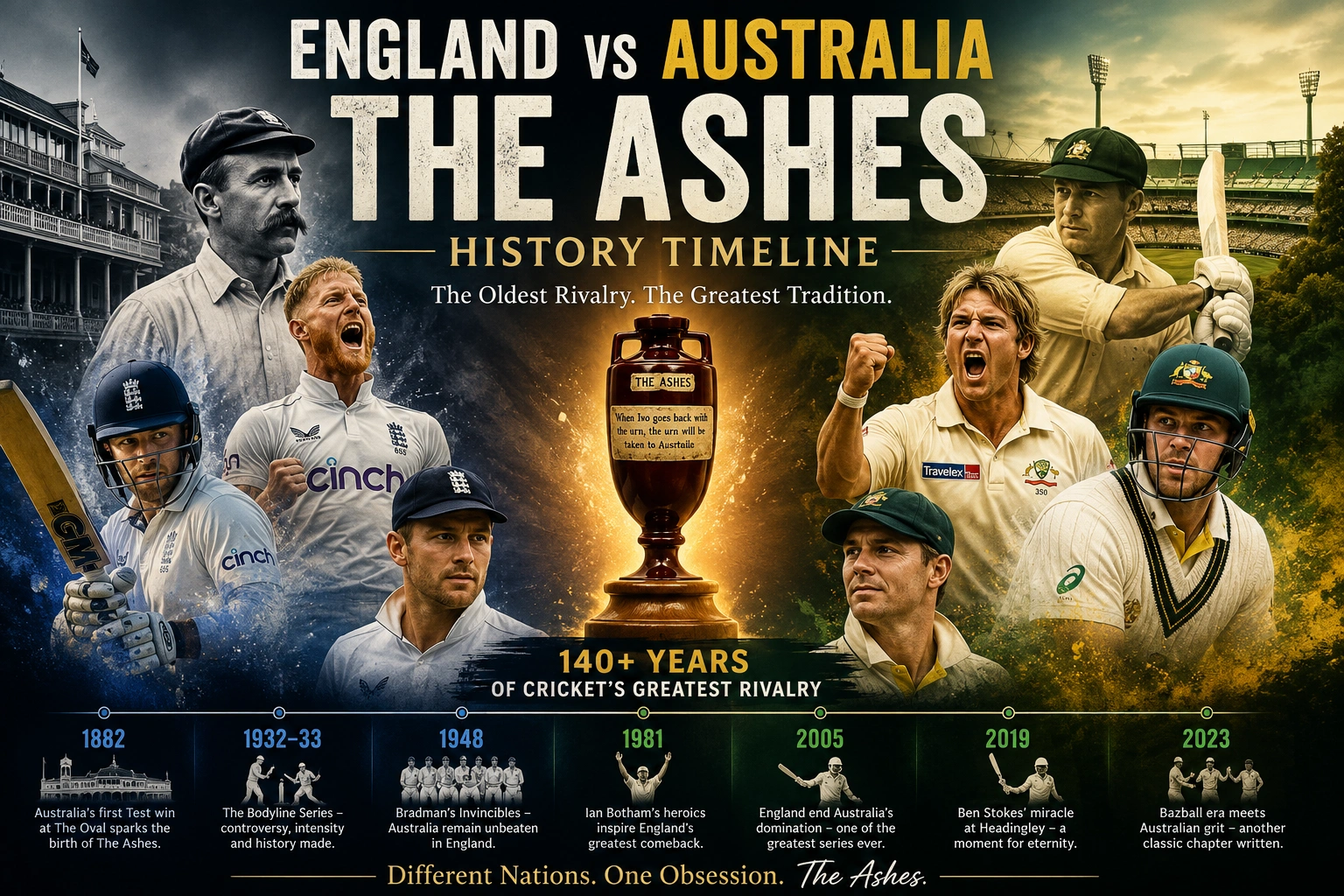
Some sporting rivalries are built over decades. Others stretch across generations and become part of history itself. The Ashes belongs to the second category. For more than 140 years, England and Australia have battled not only for victories but for pride, legacy, and cricketing supremacy. Every series adds another unforgettable chapter—from dramatic comebacks and legendary captains to iconic innings that fans still talk about today. Here’s a complete England vs Australia Ashes history timeline, explaining how cricket’s most celebrated Test rivalry evolved into one of the biggest events in world sport.
Quick Summary
- The Ashes began in 1882after Australia’s historic victory at The Oval.
- The name “The Ashes” originated from a satirical newspaper obituary.
- England regained the urn during the 1882–83 tour of Australia.
- More than 70 Ashes serieshave been played.
- Australia has won more Ashes series overall than England.
- Legendary players include Don Bradman, Ian Botham, Shane Warne, Steve Waugh, Alastair Cook, Ben Stokes and Joe Root.
- The Ashes remains the oldest and most prestigious rivalry in Test cricket.
How Did the Ashes Begin?
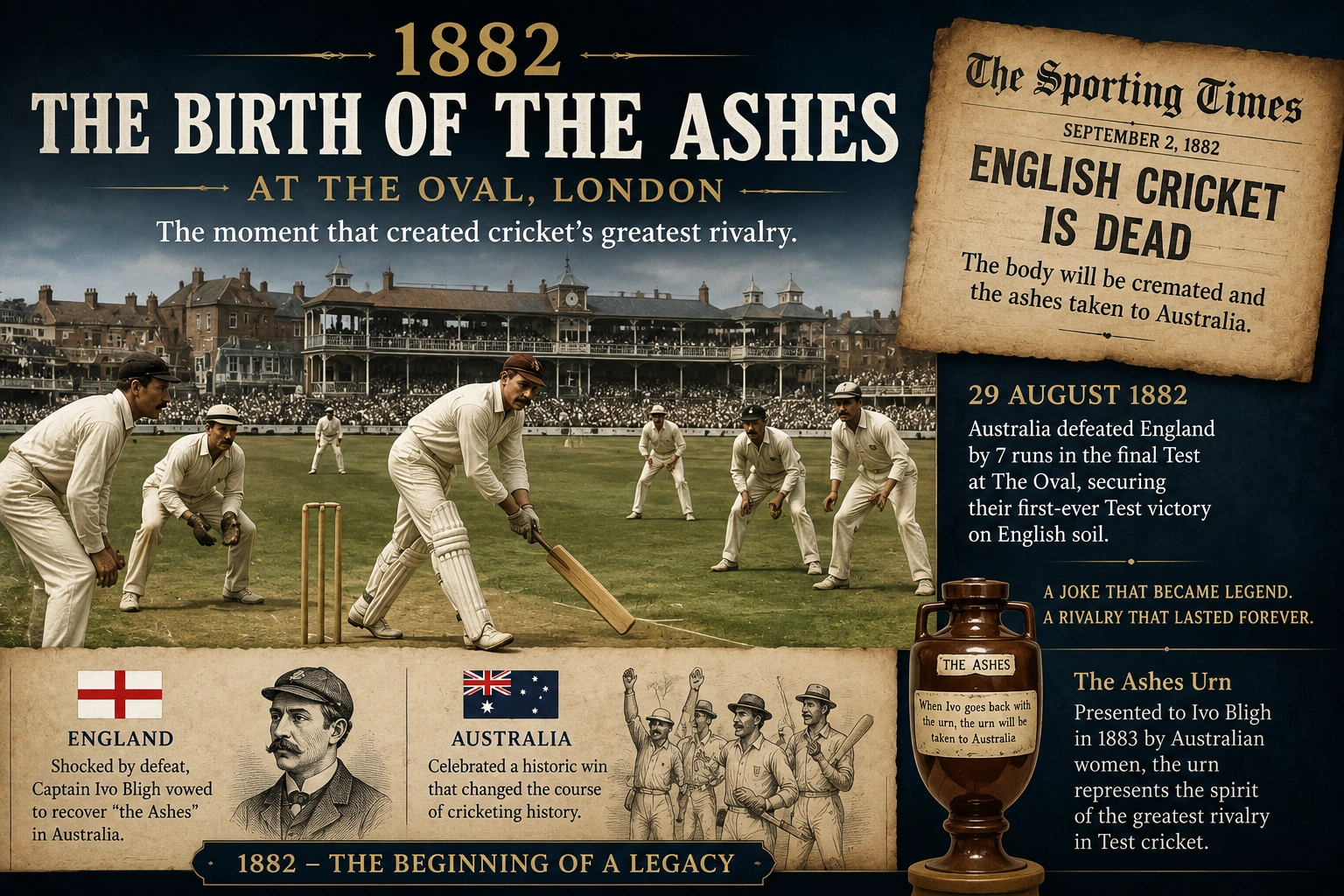
The Ashes story started on 29 August 1882 at The Oval in London.
Australia defeated England by just seven runs, recording its first-ever Test victory on English soil. The defeat shocked English cricket supporters, who had expected an easy victory.
The following day, British newspaper The Sporting Times published a humorous obituary declaring that English cricket had “died” and “the body will be cremated and the ashes taken to Australia.”
No one imagined that a joke would become cricket’s most famous tradition.
England captain Ivo Bligh promised to recover “the Ashes” during the 1882–83 tour of Australia. After England won the series, Bligh received a small terracotta urn from a group of Melbourne women. Although the original urn remains safely displayed at Lord’s Cricket Ground, replicas are now presented to the winning team.
England vs Australia Ashes History Timeline
1882–83: Birth of Cricket’s Greatest Rivalry
England successfully reclaimed “the Ashes” during the tour of Australia.
This series officially established what would become the oldest rivalry in international cricket.
Early 1900s: Australia Emerges as a Cricket Power
Between 1890 and 1914, Australia developed into one of the world’s strongest Test teams.
Players such as Victor Trumper inspired Australian cricket, while England continued producing talented professionals who kept the rivalry fiercely competitive.
Ashes contests regularly attracted huge crowds and newspaper coverage across both countries.
1930: Don Bradman’s Historic Dominance
No player has shaped the Ashes more than Sir Donald Bradman.
During the 1930 Ashes, Bradman scored an astonishing 974 runs, which remains the highest tally by any batter in a single Test series.
His remarkable consistency forced England to rethink its bowling strategy completely.
1932–33: The Bodyline Series
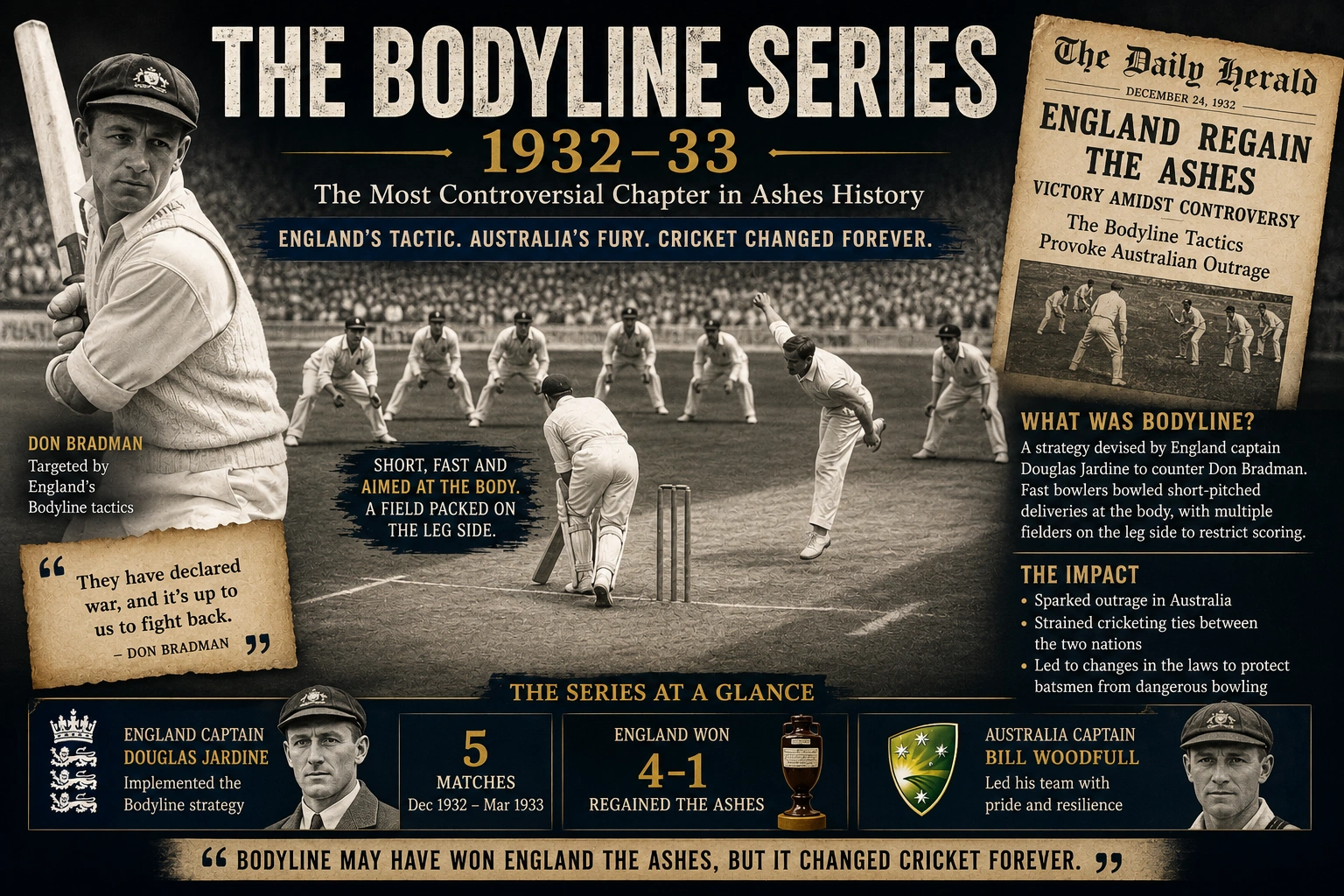
Perhaps the most controversial chapter in Ashes history arrived during the 1932–33 Bodyline series.
England captain Douglas Jardine instructed fast bowlers, particularly Harold Larwood, to bowl short-pitched deliveries aimed at Bradman’s body while packing the leg side with fielders.
Although England regained the Ashes, the tactic sparked diplomatic tensions between England and Australia and eventually led to changes in cricket laws regarding dangerous bowling.
Even today, Bodyline remains one of cricket’s most debated tactical decisions.
1948: Bradman’s Invincibles
Australia toured England unbeaten throughout the summer.
Known as The Invincibles, Bradman’s team completed one of the greatest achievements in cricket history by remaining undefeated during the entire tour.
Ironically, Bradman’s career ended with a duck at The Oval, leaving him with a Test batting average of 99.94, just four runs short of the magical 100.
The Modern Ashes Era
1981: Ian Botham’s Miracle Series
The 1981 Ashes changed English cricket forever.
After resigning as captain, Ian Botham produced one of the greatest individual performances in sporting history.
His remarkable century at Headingley, followed by match-winning bowling performances throughout the series, inspired England to an unforgettable comeback from 1-0 down.
Today, the series is simply remembered as “Botham’s Ashes.”
1989–2003: Australia’s Golden Generation
Australia dominated world cricket throughout the 1990s and early 2000s.
Under Allan Border, Mark Taylor and later Steve Waugh, Australia consistently outplayed England.
The emergence of Shane Warne added another dimension.
Warne’s famous “Ball of the Century” to Mike Gatting in 1993 remains one of cricket’s most iconic deliveries and symbolized Australia’s superiority during that era.
2005: One of the Greatest Test Series Ever
Ask many cricket fans about their favourite Ashes series, and they’ll mention 2005.
England finally ended Australia’s long dominance by winning 2-1.
The series featured:
- Edgbaston thriller
- Flintoff’s all-round brilliance
- Kevin Pietersen’s unforgettable Oval century
- Shane Warne’s extraordinary 40 wickets
- Packed stadiums across England
Many historians still consider the 2005 Ashes the greatest Test series ever played.
2013–14: Australia’s Complete Revenge
England entered Australia hoping to retain the Ashes.
Instead, Australia completed a stunning 5-0 whitewash under Michael Clarke.
Mitchell Johnson’s devastating pace transformed the series, frightening England’s batting lineup with one of the greatest fast-bowling performances in Ashes history.
2019: Ben Stokes Creates Headingley Magic
The third Test at Headingley instantly became an Ashes classic.
Chasing 359, England looked beaten before Ben Stokes produced an unbeaten 135, guiding England to an incredible one-wicket victory.
It remains one of the finest fourth-innings performances ever witnessed in Test cricket.
The series ended 2-2, allowing Australia to retain the Ashes.
2023: Bazball Meets Australia’s Champions
The 2023 Ashes attracted worldwide attention because of England’s aggressive “Bazball” philosophy.
The five-Test series delivered exceptional entertainment.
Highlights included:
- Pat Cummins’ Edgbaston heroics
- Alex Carey’s controversial Jonny Bairstow stumping
- Ben Stokes’ remarkable century at Lord’s
- Stuart Broad retiring after England’s Oval victory
The series finished 2-2, with Australia retaining the Ashes after winning the opening two Tests.
Ashes Series Winners Through History
While England invented cricket, Australia has historically enjoyed greater success in the Ashes.
Across more than seven decades of contests:
- Australia has won the majority of Ashes series.
- England has produced several memorable eras, particularly in the 1950s, early 1980s and 2005.
- Several series have ended in draws, allowing the holders to retain the urn.
Australia’s sustained excellence during the Bradman era and the late-1990s golden generation significantly strengthened its overall record.
Greatest Players in Ashes History
The Ashes has produced countless legends, but a few names stand above the rest.
Sir Donald Bradman (Australia)
- 5,000+ Ashes runs
- Test average of 99.94
- Most influential batter in cricket history
Shane Warne (Australia)
- 195 Ashes wickets
- Ball of the Century
- Revolutionized leg-spin bowling
Ian Botham (England)
- Hero of the 1981 Ashes
- Match-winning all-round performances
- One of England’s greatest cricketers
Alastair Cook (England)
England’s highest Ashes run-scorer, admired for his patience and consistency against Australia’s world-class bowling attacks.
Ben Stokes (England)
Known for producing unforgettable moments under pressure, especially the Headingley miracle in 2019.
Joe Root (England)
One of England’s most prolific Test batters, Root has consistently delivered significant performances in Ashes contests across multiple series.
Why Does the Ashes Matter So Much?
Unlike many bilateral cricket series, the Ashes carries emotional weight far beyond the trophy itself.
Several factors make it unique:
- More than 140 years of uninterrupted history.
- National pride between England and Australia.
- Historic venues including Lord’s, The Oval, Headingley, Melbourne Cricket Ground and Sydney Cricket Ground.
- Legendary individual performances remembered for generations.
- Every series shapes cricket history.
Winning the Ashes often defines careers.
Captains are remembered by whether they lifted the urn, while players build lasting reputations through memorable Ashes performances.
FAQs
When did the Ashes begin?
The Ashes began in 1882 after Australia defeated England at The Oval. A satirical newspaper obituary inspired the famous name, and England reclaimed the symbolic Ashes during the following tour of Australia.
Why is it called the Ashes?
The name comes from a newspaper article published after England’s defeat in 1882, humorously stating that English cricket had died and its ashes would be taken to Australia.
Which team has won the most Ashes series?
Australia has won more Ashes series than England across the rivalry’s long history, thanks largely to dominant periods during the Bradman era and the late 20th century.
Who is the greatest Ashes player of all time?
Most cricket historians consider Sir Donald Bradman the greatest Ashes player because of his extraordinary batting average, record-breaking run tally, and unmatched influence on the rivalry.
Conclusion
The England vs Australia Ashes history timeline is far more than a sequence of cricket matches. It is a story of tradition, fierce competition, unforgettable personalities, and moments that have shaped the sport for well over a century. From the birth of the urn in 1882 to modern classics at Headingley and Lord’s, every Ashes series adds another layer to cricket’s richest rivalry. As new generations of players take the field, one thing remains unchanged—the Ashes continues to set the benchmark for Test cricket excellence.
